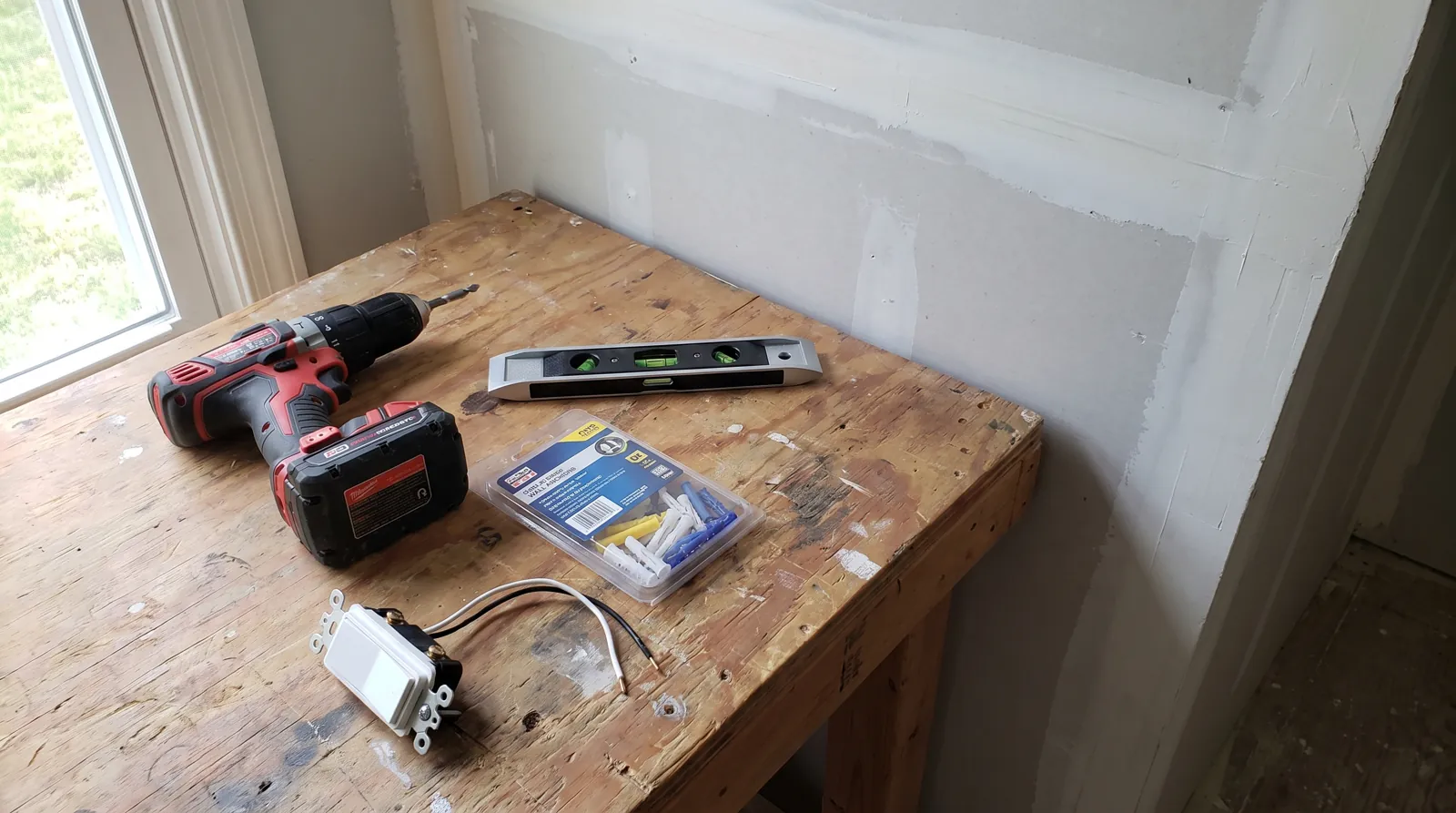
This home installation guide is the index for the second half of the site. The first half asks why a device stopped working. This half asks the question that comes right before that: how do I attach this thing to my house so it works and stays put. Shelves, TV brackets, smart locks on rental doors, dimmers, LED strips under cabinets.
Each linked guide is built the same way. The answer in the first three sentences, the reason it works, numbered steps, and a clear line where the job stops being a homeowner job. Numbers come from manufacturer datasheets and installation sheets, linked in each article.
Home installation guide, part one, holding weight
Most “it fell off the wall” stories have the same cause. The anchor’s printed rating was read as a working load, when it was a failure load measured in a lab, straight down, in perfect drywall. Real walls are older, loads pull outward, and people hang heavier things than they planned.
Start with Toggle bolt vs molly bolt which is stronger? Divide by four. It explains the divide-by-four rule, when a toggle is worth the bigger hole, and which jobs should go into a stud no matter what the packaging says.
Lighting: dimmers, LED bulbs and strips
LED lighting causes more installation grief than any other category, because the parts look interchangeable and are not. A dimmer built for incandescent bulbs will make an LED bulb flicker, buzz, or refuse to go dim. A strip wired to a switch with a smart module can glow faintly all night from leakage current alone.
Two guides cover this. Will a dimmer switch work with LED bulbs? Only if both match is the one to read before buying anything, and LED strip flickering when off? It’s leakage, not a fault is the one to read after the strip is already up and misbehaving.
Doors and locks on a rental
A smart lock is an installation problem first and a compatibility problem second. The door has to be the right thickness, the deadbolt has to be a standard size, and in a rental the whole thing has to come off cleanly when you move out. The compatibility side is covered in the smart home section: Smart lock compatible with Home Assistant? Check the radio.
The line where you stop
Some jobs on this site involve mains wiring: swapping a dimmer, adding a smart switch, moving a fixture. The guides take you as far as checking what is in your switch box and no further. That is deliberate.
In the US, whether you may legally do your own wiring depends on your state and sometimes your city, and a permit is often required even when it is allowed. In the UK, most fixed wiring work falls under Part P of the Building Regulations and needs a registered electrician or building control sign-off. Insurance claims after a fire will ask who did the work.
So every wiring-adjacent guide ends at the same place: you have confirmed what your box contains, you know what the new device needs, and the next step is either a licensed electrician or a different, no-wiring product. Smart bulbs instead of smart switches. A plug-in dimmer instead of a wall dimmer. Those are real solutions, not consolation prizes.
How the numbers on packaging actually work
Anchor packaging prints an ultimate load: the force at which the anchor pulled out or the drywall crumbled in a test rig, pulling straight out or straight down, in fresh half-inch board. Three things make your wall worse than the rig. Your drywall is older and may have been patched. Your load is probably not straight down; a shelf with books on the front edge levers outward. And the anchor will be loaded for years, not for the ten seconds of a test. Installers divide the printed number by four for a working load, and by more for anything that moves, like a towel bar or a folding table.
Dimmer packaging prints a wattage, but for LED bulbs the wattage is almost irrelevant. What matters is whether the dimmer is a trailing-edge or leading-edge design and whether the bulb is on the dimmer maker’s compatibility list. A 600 W incandescent dimmer driving four 9 W LED bulbs is nowhere near its rating and can still flicker, because the bulbs do not draw enough current to keep the dimmer’s electronics stable. The dimmer guide walks through reading both datasheets side by side.
LED strip packaging prints watts per metre and a voltage. The number that is missing is the one that causes the glow-when-off complaint: leakage through a smart switch or a dimmer that is never fully open. That is why the strip guide starts by asking what is switching the strip, not what the strip is rated for.
Before you drill
Three habits that prevent most repeat trips to the hardware store.
Find the stud, or confirm there isn’t one, before choosing an anchor. A cheap magnetic stud finder is enough for drywall over wood studs.
Read the load rating on the device, not just the anchor. A TV bracket rated for 40 kg mounted with anchors rated for 10 kg each is held up by the weakest number, and by the wall.
Photograph the inside of any box before you disconnect a single wire. It is the one step nobody regrets.
One action: pick the guide that matches the thing in your hand, and check the rating on its box against the number in the article before you buy anchors.

Bolt & Bulb covers what goes wrong after the unboxing: devices that drop off Wi-Fi, dimmers that flicker with LED bulbs, locks that will not fit a rental door. The site draws on manufacturer documentation, platform support pages and release notes, and attributed owner reports in public forums.