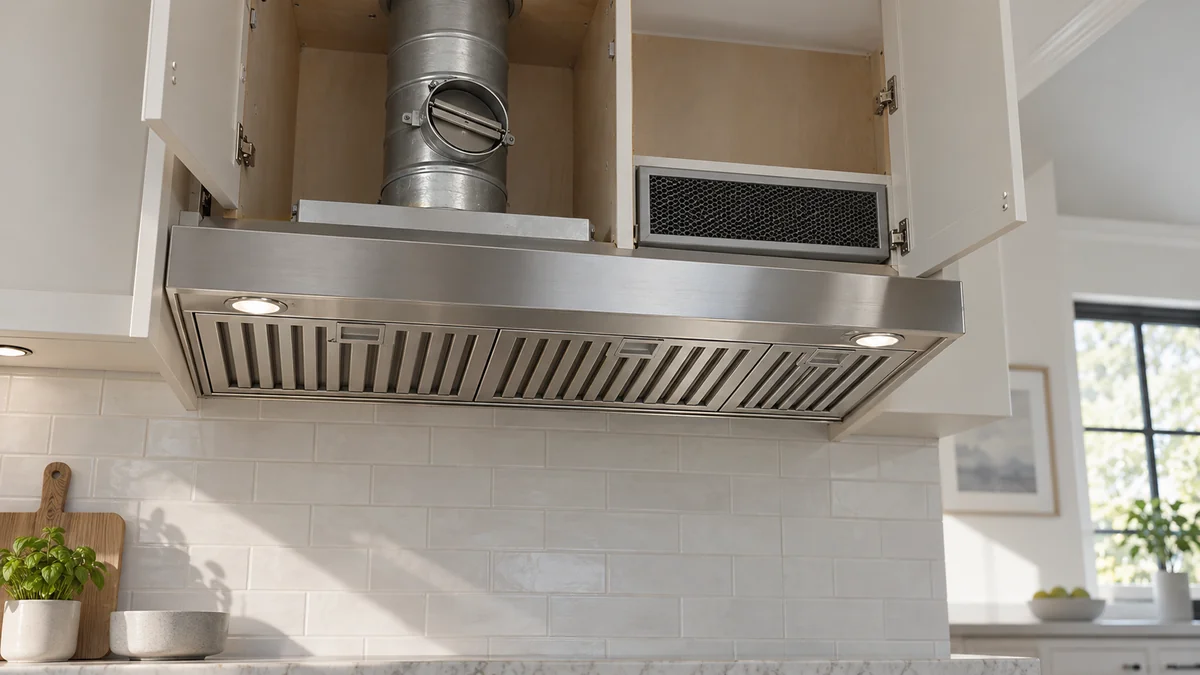
Can a ductless range hood be converted to ducted? Yes, but only when the exact model is listed as convertible or approved for a vented installation.
If its specifications say non-vented only, replace the hood instead of cutting a hole and trying to add a collar. For a convertible unit, confirm the outlet, duct route, exterior cap, and local rules before buying parts.
Use the home installation guide to map an unknown path through a cabinet, wall, or ceiling. Measure that path before you shop.
Keep app control or smart-switch work separate with the smart-home troubleshooting map.
A network link cannot make an unsupported hood vent outdoors.
Can a ductless range hood be converted to ducted? Read the model line
“Ductless” can describe how a hood is operating today, not everything the appliance can do. A convertible hood may be installed with a charcoal filter and recirculation deflector now, then configured for outdoor exhaust when an approved duct is added.
A ductless-only hood is different.
GE Appliances says a non-vented hood cannot be changed to vented. It allows the change only when the model’s features or specs call it convertible.
That makes the model number and manual the first gate.
A grille or removable filter does not prove the hood can vent outside.
Find the full model number on the rating label behind a filter, under the hood, or in the location named by the owner’s guide. Search the manufacturer’s support site for that exact number and look for both “vented” and “non-vented” installation sections.
Do not borrow a manual from a similar-looking hood.
“Convert kitchen hood from ductless to ducted to outside?” — the question from a homeowner in r/DIYUK.
The word “outside” is the useful part. A real conversion needs an approved exit path to outdoor air, not a tube ending above a cabinet, in an attic, or inside a wall cavity.
Run three checks before buying a duct kit
- Capability: Does the exact manual show a vented configuration, outlet direction, and required transition or damper? If not, stop and price a replacement hood.
- Route: Can the specified duct size reach a listed wall or roof cap without being reduced, crushed, or forced through too many turns? Sketch the path through the cabinet, framing, and exterior surface.
- Local requirements: Does the hood’s airflow trigger a permit, makeup-air provision, or another rule where you live? Ask the local authority or installer before choosing blower capacity.
These are three separate yes-or-no decisions. Passing the first does not rescue a route that cannot reach outdoors, and a clear route does not authorize a ductless-only blower housing.
| What you find | What it means | Next purchase |
|---|---|---|
| Manual says non-vented only | The existing hood is not a conversion candidate | Compatible replacement hood |
| Manual shows vented and recirculating layouts | The hood can be considered for conversion | Only the model-listed transition, duct, damper, and cap |
| Manual is missing or model number is incomplete | Capability is unverified | Nothing until the manufacturer confirms it |
Whirlpool’s current convertible range hood guide makes the same split. Convertible models can use a duct or recirculate air.
The setup changes with the vent mode.
Whirlpool tells owners to use the exact manual and consider a trained installer.
That is not boilerplate.
One Whirlpool manual, W10836364B, calls for a 6-inch round metal duct, a damper, and an outdoor exit. It warns against flex duct.
That sample system allows 35 equivalent feet.
Each 90-degree elbow uses 5 feet of that limit.
Those figures belong to the models covered by that manual. They are an example of what to extract from your own manual, not universal dimensions for every range hood.
When the duct route kills the conversion
The hood may be convertible while the kitchen is a poor fit for the work. The route can meet a joist or reach a place where an outside vent is not allowed.
A long run, several elbows, or unsafe access can make a new hood or a pro-built route the better choice.
Use rigid metal duct when the manual calls for it. Keep the same duct size from the hood to the cap.
The Whirlpool manual also calls for few elbows, sealed joints, and a damper. It says the duct must end outside, not in an attic or closed space.
Every restriction spends airflow.
Broan-NuTone’s duct length tool asks for the fan model, duct width, duct type, and elbow count. Those inputs change airflow at the hood.
Its range-hood tool says makeup air is often required around 400 CFM. Local rules set the real trigger.
Use that 400 CFM figure as a prompt to ask, not as permission to install. The Whirlpool manual likewise says the applicable airflow threshold varies by location and tells owners to consult an HVAC professional.
Stop the DIY plan if the project adds or moves mains wiring, crosses a fire-rated assembly, requires a roof opening, or could affect a shared duct in an apartment. This article is a screening method, not a wiring or wall-penetration procedure.
My recommendation is simple: replace a ductless-only hood, and get a route quote before converting a supported model. Do not buy a generic conversion kit first and hope the parts reveal what the appliance accepts.
Take a six-line scope to the installer
A useful quote starts with facts that another person can verify. Put the full model number, approved outlet shape and size, proposed wall-or-roof exit, straight-run length, elbow count, and rated airflow on one page.
Add photos of the rating label, cabinet, likely route, and outside vent site. Give the installer a clear view before the visit.
Ask the installer to list the transition, backdraft damper, cap, makeup-air work, electrical work, and permit in the quote.
This prevents two common estimates from being compared as if they cover the same job. One price may include only attaching a hood to existing duct, while another includes opening and sealing an exterior path.
Keep the charcoal filter until the vented installation is complete and tested according to the model instructions. Removing recirculation parts does not create a working exhaust route by itself.
If the manufacturer cannot produce the exact installation manual, treat that as a failed capability check. A new convertible hood with documented venting options is easier to price and safer to install than an undocumented modification.
Do this now: photograph the model plate and download the exact installation manual.
Circle the words “vented,” “convertible,” or “non-vented only,” then copy the outlet size and maximum route into your six-line scope. That one page answers can a ductless range hood be converted to ducted before a cabinet is cut or the wrong kit is ordered.

Bolt & Bulb covers what goes wrong after the unboxing: devices that drop off Wi-Fi, dimmers that flicker with LED bulbs, locks that will not fit a rental door. The site draws on manufacturer documentation, platform support pages and release notes, and attributed owner reports in public forums.