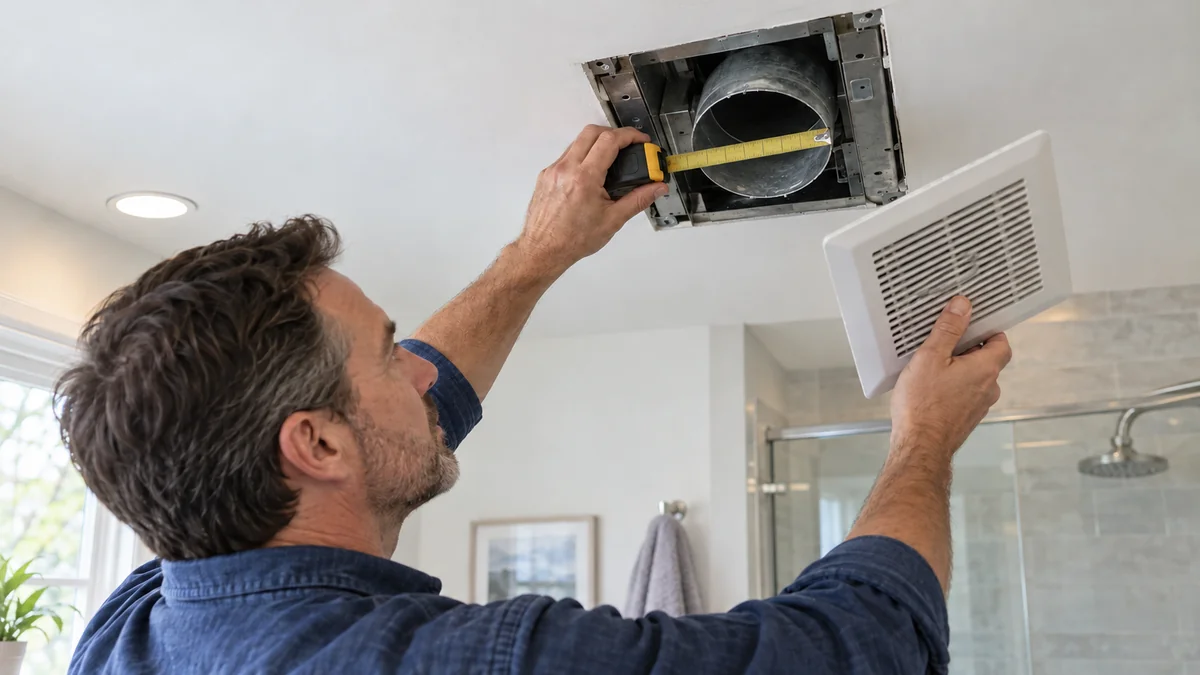
Bathroom exhaust fan duct size is not a number you should choose from CFM alone.
Match the exact fan manual to the narrowest part of the existing route, including the collar, hidden duct, bends, and exterior cap.
If any fixed section is smaller than the model permits, choose another fan or include a duct change in the installation quote before you buy.
The buying rule: enough CFM for the room is only the first test. The fan also needs a documented path to the outdoors at the diameter, material, and length its maker allows.
Use the home installation guide to record the opening and model number without disturbing wiring. Our smart-home troubleshooting map uses the same principle: identify the constrained handoff before replacing hardware.
Bathroom exhaust fan duct size starts with the manual
First calculate how much ventilation the room needs. Do not let that answer choose the duct by itself.
Broan-NuTone’s bath fan FAQ uses room length, width, ceiling height, and a 0.13 factor for bathrooms under 100 square feet, then rounds up to the next ten. Its example turns a 10-by-8-foot room with a 9-foot ceiling into a minimum 100 CFM choice.
That calculation tells you the airflow target. It does not prove that an old three- or four-inch duct can deliver the new fan’s rated airflow.
The same manufacturer says using a smaller duct than the fan was designed for is not recommended because it reduces CFM and adds noise. Larger duct may improve performance, but the transition, housing damper, and model instructions still have to fit.
Download the installation guide for the exact model, not a nearby series name. Copy its outlet diameter, permitted duct material, route warnings, and any performance table into your notes.
A nominal 80 CFM or 110 CFM label is not a substitute for those four lines.
Five observations decide whether the old duct can stay
Remove only the grille if the current fan’s owner instructions treat that as normal cleaning access. Switch the circuit off first, and stop if reaching the label would expose wiring, sharp metal, unstable attic flooring, or a wet housing.
From safe, visible locations, record these five facts: the current model number, outlet diameter, smallest visible duct diameter, straight-run length, and number of bends before the outdoor cap.
Add the duct material and termination location beside the card. Those details do not require you to disconnect the housing.
| What you find | Purchase decision | Why |
|---|---|---|
| Every fixed section meets the new manual | Keep the model on the shortlist | Size passes, but route length and bends still need checking |
| A hidden or visible section is smaller | Choose another fan or quote a full duct change | An adapter does not remove the smaller restriction |
| Long flex duct or tight bends dominate the route | Ask for a route correction before buying more CFM | Ribs and turns add resistance |
| The duct ends in an attic or wall cavity | Price a proper outdoor termination | Recirculating moisture is not ventilation |
| The path cannot be seen safely | Get an installer survey | A delivery-day guess is more expensive than a site check |
A homeowner report shows why the route belongs on the card. A 110 CFM fan barely moved air after it was connected to roughly 12 feet of flex duct and a 180-degree turn.
The report does not prove a universal loss percentage. It shows that a correct-looking fan number can fail when the installed path is ignored.
A reducer cannot rescue the wrong purchase
A reducer makes two diameters connect. It does not make the smaller section carry air like the larger section.
If a six-inch fan outlet immediately narrows into an old four-inch run, the four-inch section remains the constraint.
Buying a stronger motor without checking the performance data can produce more noise instead of useful exhaust.
Rigid duct is the safer comparison point because its smooth interior creates less resistance. Broan-NuTone recommends rigid duct where possible and says flexible duct should be kept as straight as possible.
The manufacturer also says a bath fan must exhaust outdoors, not into a ceiling, attic, crawl space, garage, or wall cavity. That turns an improper termination into an installation-cost decision, not a reason to buy a duct-free fan.
Duct-free units do not remove bathroom air. They cannot replace a vented fan when moisture control is the job.
If the old fan is already weak, run the safe location tests in our bathroom exhaust airflow guide before assuming the motor is too small.
A blocked damper or crushed run can defeat the replacement too.
Stop at mains wiring, roof work, concealed duct changes, combustion-air questions, and any wet electrical housing.
A licensed electrician or qualified ventilation installer should inspect those conditions and confirm local code.
Three questions to answer before checkout
Can I put a four-inch fan on a three-inch duct?
Only if the fan’s own guide allows that diameter. A shelf adapter does not override the model specification.
Should I buy a higher-CFM fan for a long duct?
Not from the CFM label alone. Compare the model’s performance information at the expected duct size and resistance, or have the installer price a shorter, straighter, or larger route.
Is a larger existing duct always compatible?
No. Larger diameter usually reduces resistance, but the housing outlet, approved transition, damper clearance, insulation, and exterior cap still have to match the manual and local requirements.
Do this now: photograph the current label, write down the five visible duct facts, and place them beside one replacement model’s installation guide.
If the smallest section fails that comparison, remove the fan from your cart or request a quote that includes the whole route. That is the useful answer to bathroom exhaust fan duct size before delivery day.

Bolt & Bulb covers what goes wrong after the unboxing: devices that drop off Wi-Fi, dimmers that flicker with LED bulbs, locks that will not fit a rental door. The site draws on manufacturer documentation, platform support pages and release notes, and attributed owner reports in public forums.