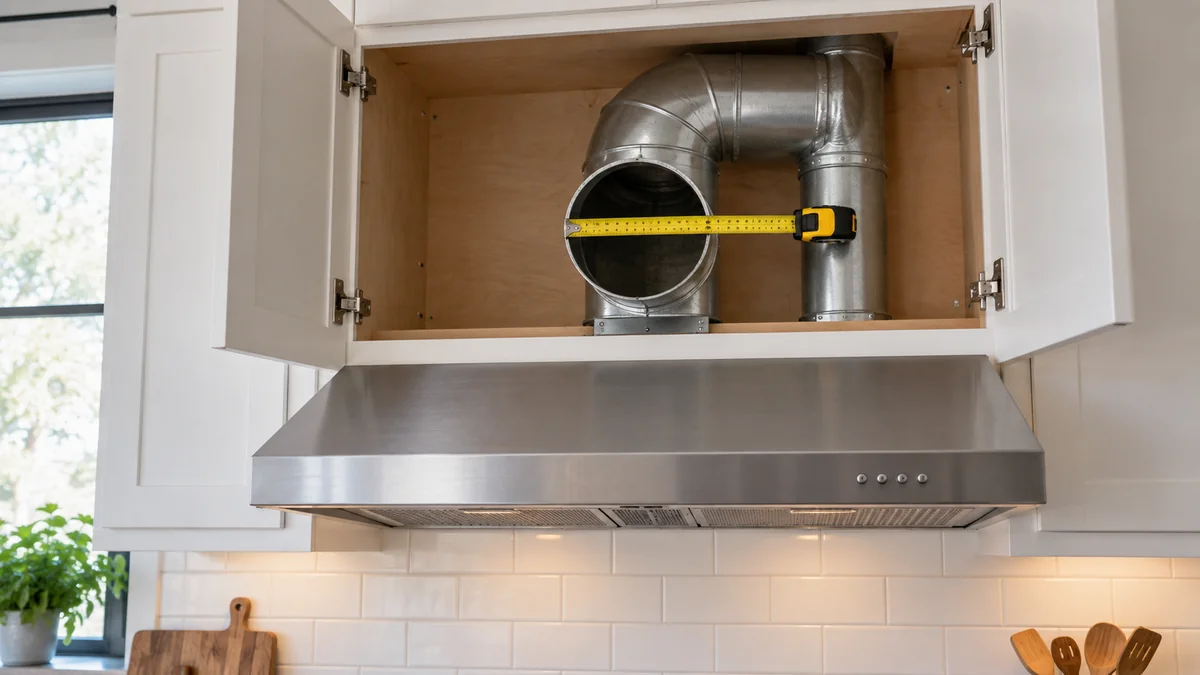
Range hood duct size for replacement should come from the new hood’s installation manual, not from the old hood’s width or a generic CFM chart.
If your existing duct is smaller than the model’s stated minimum, choose a compatible hood or price a duct upgrade before ordering.
If it is the same size or larger, you still need to check the outlet shape, run length, elbows, and exterior cap before calling it a fit.
The buying rule: the narrowest fixed section must meet the new hood’s manual. A reducer does not turn an undersized run into a match.
Start with the home installation guide if you need a quick way to record the opening, model number, and stopping point. The same evidence-first habit appears in our smart-home troubleshooting map: identify the failed handoff before replacing hardware.
Range hood duct size for replacement starts with two labels
Remove the grease filter only if the old hood’s instructions describe that as normal maintenance.
Photograph its model label and the visible outlet or transition without disconnecting wiring, cutting metal, or opening a wall.
Then download the installation manual for each replacement model on your shortlist.
The product page’s 30-inch or 36-inch width describes coverage over the cooktop. It does not specify the duct hidden above the cabinet.
Write down five fields for the old system: duct shape and inside dimensions, straight-run length, number of elbows, exit point, and wall- or roof-cap size. For the new hood, copy the permitted outlet shapes, minimum size, maximum equivalent length, CFM rating, and make-up-air note.
Do not estimate a round duct by wrapping a tape around it and treating that circumference as the diameter. Measure straight across the inside of a safely exposed end, or ask the installer to identify it if the connection is still assembled.
Broan-NuTone’s range hood FAQ says most of its hoods use at least 3¼ by 10-inch rectangular duct. It describes that as equivalent to 6-inch round.
More powerful models can require round duct up to 10 inches. Broan also warns against reducing below the chosen model’s specification.
That manufacturer language settles the shopping order.
Pick the exact model, read its manual, and then compare the existing path. Do not buy from a universal “CFM-to-diameter” chart.
The narrowest section decides whether the old duct survives
The hood collar is only the first section.
A six-inch collar connected to a five-inch pipe inside the wall still leaves a five-inch restriction. A proper transition from a smaller hood outlet into a larger existing run may be acceptable when the manual allows it.
One r/HVACAdvice question captured the real purchase problem. A 375 CFM hood required 7-inch round duct, but the house ended at a 6-inch roof cap.
The cap and the concealed section make that whole system smaller than the hood’s documented path.
| What you find | Purchase decision | Reason |
|---|---|---|
| Existing duct is smaller than the manual minimum | Choose another hood or quote a full duct upgrade | A reducer preserves the smaller restriction |
| Existing size and shape match | Check run length, elbows, damper, and exterior cap | Matching the outlet alone does not prove airflow |
| Existing duct is larger | Confirm an approved gradual transition | The hood collar and damper still need clearance |
| Any section is plastic, dryer duct, or crushed flex | Price smooth metal replacement | Material and interior ridges affect safety and airflow |
| The outlet is offset from the old opening | Get a sheet-metal fit plan before ordering | A sharp improvised bend adds resistance and may block the damper |
Six feet of duct can act like a fifty-foot run
Broan-NuTone specifies metal duct and prefers smooth metal over flexible metal. It says never to use plastic or four-inch dryer duct for its range hoods.
It also recommends the shortest practical path with the fewest turns.
Every fitting consumes part of the allowed run. One Whirlpool installation guide, for example, assigns five equivalent feet to a rectangular-to-round transition, ten feet to one type of 90-degree elbow, and forty feet to its listed wall cap.
Those numbers belong to that documented system, not every hood.
The lesson travels: six physical feet of duct can behave like a much longer run once the transition, bend, and cap are counted.
Over 400 CFM can add a second installation decision
A higher CFM number is not automatically an upgrade.
Before paying for more airflow, check the local make-up-air threshold. Then ask whether the current duct can deliver the advertised performance.
Broan-NuTone’s make-up-air guidance says the code language it cites applies to systems capable of exhausting more than 400 CFM.
States and cities may amend that threshold, so check the local jurisdiction.
Ask the permit office or installer which rating your local rule uses. Also ask what replacement-air design, if any, the house requires.
This changes the price comparison. A hood that fits the cabinet but requires a larger duct, a new exterior cap, and make-up air is not a direct replacement; compare its complete installed quote with a model documented for the existing path.
Stop the homeowner inspection at hidden ductwork, hard-wired connections, roof access, sharp sheet metal, or any change to combustion-air planning. Those are installation tasks for qualified trades, not measurements to improvise after delivery.
Three questions to settle before checkout
Can I use a reducer on a range hood duct?
Not to connect a hood to a run smaller than its manual allows.
If the hood outlet is smaller and the existing duct is larger, a gradual transition may work. The exact manual must permit it, and the damper must open freely.
Is 3¼ by 10-inch rectangular the same as 6-inch round?
They are common alternative sizes, but they are not identical shapes. The rectangle has 32.5 square inches of area, while a six-inch circle has about 28.3; bends, seams, and transitions add resistance that area alone cannot predict.
Use the shapes named in the model manual rather than treating that calculation as permission to substitute one for the other.
Should I keep an old flexible duct because its diameter matches?
No, not on diameter alone. Broan-NuTone says smooth metal is preferable because flexible metal ridges diminish airflow, and it rules out plastic and dryer duct; have the installer compare the visible and concealed material with the hood manual and local code.
Do this before opening another product page: photograph the old hood label, measure the safely visible duct, sketch every turn to the exterior, and put those five fields beside the new model’s manual. If the required minimum is larger, remove that hood from the cart unless the written quote includes the duct change.
That one comparison makes range hood duct size for replacement a purchase filter instead of a problem discovered after delivery.

Bolt & Bulb covers what goes wrong after the unboxing: devices that drop off Wi-Fi, dimmers that flicker with LED bulbs, locks that will not fit a rental door. The site draws on manufacturer documentation, platform support pages and release notes, and attributed owner reports in public forums.