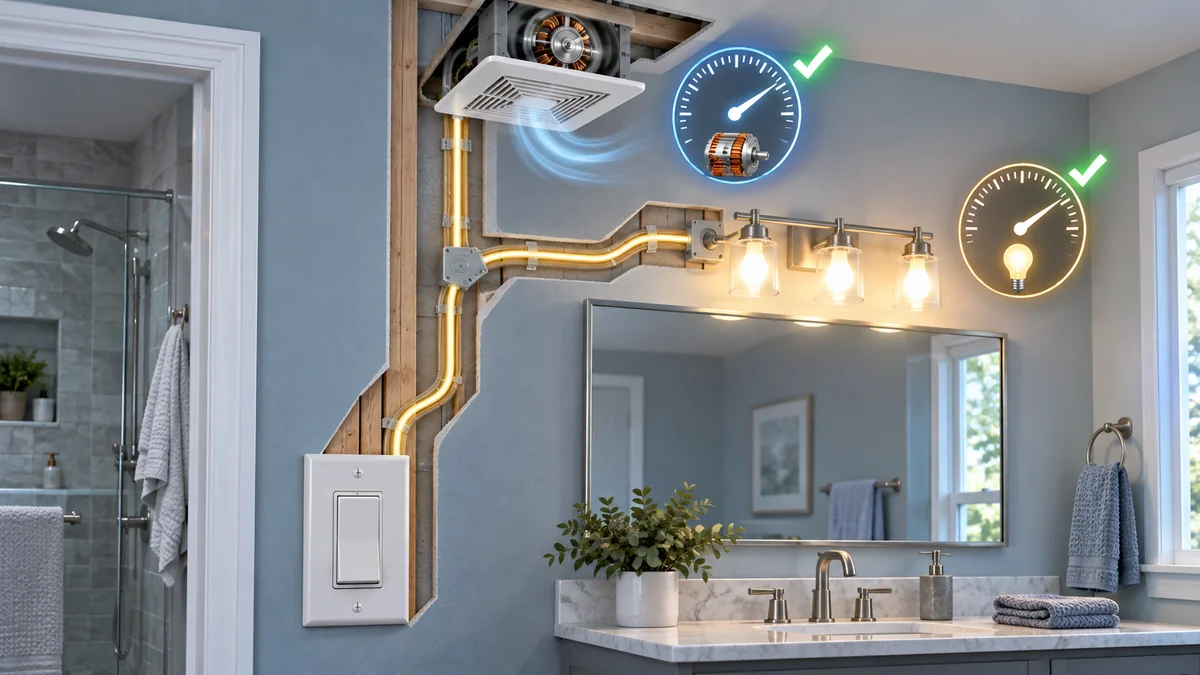
Can bathroom fan and light be on same switch? Yes, an ordinary on/off switch can control both when the switch and circuit are suitable for the combined lighting and motor loads.
Do not put that shared load on a light-only dimmer.
Keep one switch if you want the fan on whenever the room is occupied; choose separate or automatic fan control if it must keep clearing moisture after the light goes off.
The decision starts with three labels, not a wiring guess.
Turn off the breaker before anyone removes a wall plate. Do not move conductors, combine wires, or test energized parts for this article’s checks; a licensed electrician should identify and alter the bathroom circuit.
Use the home installation guide to record model numbers and wall-box limits before buying a control. If the project began as a Wi-Fi or app problem, the smart-home troubleshooting map separates device setup from the electrical work.
Can bathroom fan and light be on same switch? Check three labels
First, read the exhaust fan label or manual for voltage and current. Then read the lamp or fixture wattage and the proposed switch’s ratings for both lighting and motor loads.
A switch marked only for a lighting load is not enough evidence.
Leviton’s current countdown-timer support page says its DT series can operate motor loads such as bathroom exhaust fans and tells buyers to check the specific load rating. Another Leviton timer is explicitly rejected for an exhaust fan because its listed ratings cover resistive, tungsten, and incandescent loads rather than motors.
That manufacturer distinction matters more than the switch’s button layout or amp number on a store shelf.
Also record whether one switch already starts both loads, two switches start them independently, or the light is built into the fan. Those observations define the current behavior, but they do not prove which conductors are present in the wall box.
Let the electrician confirm that part.
One switch gives two loads the same schedule
A shared switch guarantees that the fan starts when someone turns on the light. That is useful in a household where people forget the fan, and it explains why the arrangement appears in existing bathrooms.
It also forces the fan to stop with the light.
The Home Ventilating Institute recommends leaving the fan on for 20 minutes after bathroom use and calls a timer a good way to provide that overrun. A shared instant-off switch cannot meet that target unless the light stays on for the extra time.
This is the real tradeoff. The question is not only whether one switch can carry both loads, but whether one schedule serves both jobs.
“One switch controls both the 6 vanity lights above the mirror, and the exhaust fan.”
That homeowner description from a SmartThings community discussion is common. The proposed smart dimmer failed the fit test because the motor and lamps were on the same switched load, while a regular lighting dimmer was not a fan control.
It is a hardware boundary, not an app setting.
Pick one of three control outcomes before shopping
Do not begin with a favorite smart-switch brand. Choose the behavior first, then find a listed device whose instructions cover the actual fan, light, location, and available wiring.
- Keep one on/off switch. Choose this when automatic fan use matters more than post-shower run time and an electrician confirms the existing control is suitable for the combined loads.
- Keep the loads separate. Choose this when the fan should run after the light is off, when the light needs dimming, or when you want a dedicated fan timer.
- Use automatic fan control. Choose a motor-rated timer, humidity sensor, or occupancy control when people forget the fan or leave it running too long.
Separate controls do not always require a wider wall plate. Lutron’s current dual dimmer and timer places two controls in one wall-box opening, with a lighting dimmer above and a separately rated exhaust-fan timer below.
That product example proves the concept, not compatibility with your bathroom. It still needs separate switched conductors and must meet the exact load and installation requirements in its instructions.
A humidity sensor can solve a different problem. It can start or extend fan operation according to moisture, but it should not be treated as a universal replacement for every fan/light combination.
If the wall box cannot support the plan
Stop shopping when the labels are missing, the fan model is unknown, or the proposed control manual does not name a motor load. The same rule applies when nobody can confirm whether the fan and light return to the box on separate switched conductors.
Do not buy a smart dimmer and hope software will separate a physically shared load.
Give the electrician one short packet: photos of the fan label and existing controls, the fan and light ratings, the desired behavior, and the exact control model you are considering. Ask whether the loads can stay combined, be controlled separately with existing conductors, or need new cable.
That question produces a useful estimate.
| What you find | Best next decision |
|---|---|
| One control, compatible combined load, fan use is often forgotten | Keep one motor-rated on/off control |
| Separate conductors and the fan needs overrun | Use separate light control and a fan timer |
| Missing labels, uncertain conductors, or a light-only dimmer | Pause the purchase and get the circuit identified |
If new cable or circuit changes are required, that is the stopping point for a homeowner compatibility check. Bathroom electrical rules and required protection vary with the equipment and local jurisdiction, so the person doing the work must apply the current local requirements.
A 20-minute test settles the control choice
Run the existing fan during a normal shower, turn the light off when you leave, and observe the bathroom 20 minutes later without opening electrical equipment. A wet mirror, persistent condensation, or damp surfaces show that matching the light’s schedule is not clearing moisture well enough.
That does not diagnose the fan.
Weak airflow, a blocked duct, poor makeup air, or an undersized unit can produce the same result. If the room stays damp even while the fan runs, use the bathroom exhaust fan airflow checks before spending money on a new wall control.
If the fan clears the room but stops too soon, the control choice is easier. Keep the light independent and give the fan a motor-rated timer or suitable automatic control that can cover the extra ventilation period.
Photograph the three labels now: fan, light, and proposed control. That evidence lets an electrician answer “can bathroom fan and light be on same switch” for your exact loads before you buy hardware.

Bolt & Bulb covers what goes wrong after the unboxing: devices that drop off Wi-Fi, dimmers that flicker with LED bulbs, locks that will not fit a rental door. The site draws on manufacturer documentation, platform support pages and release notes, and attributed owner reports in public forums.