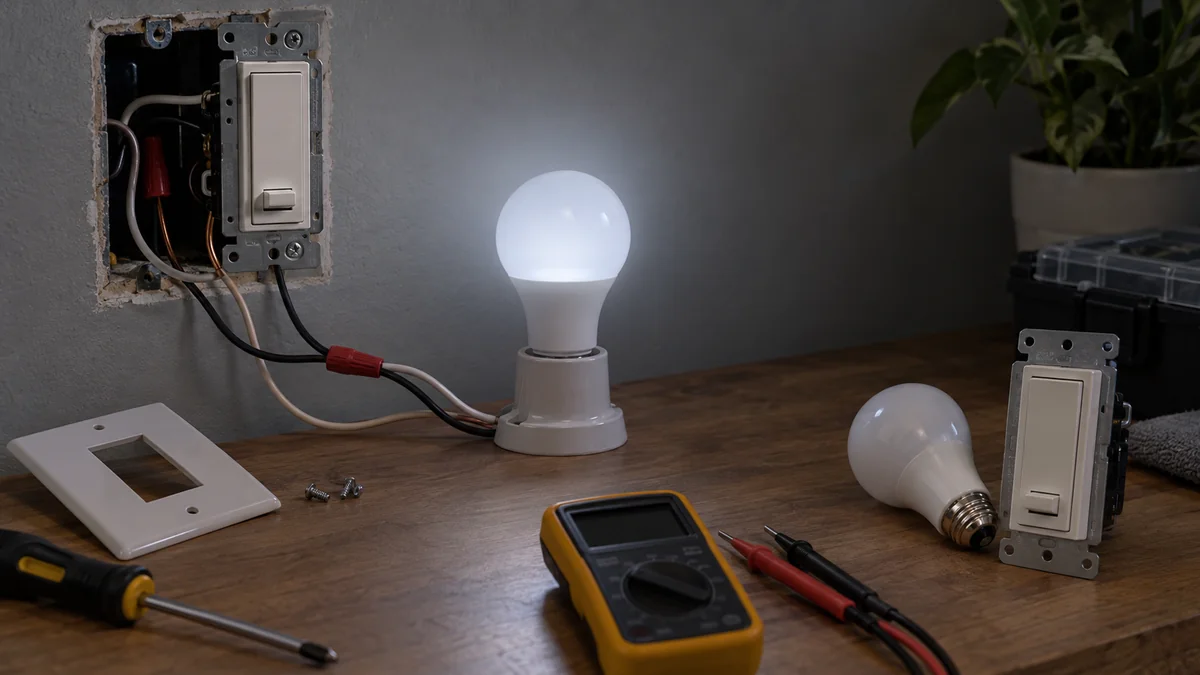
If your LED lights stay on when dimmer is off, a faint steady glow or occasional flash is often LED ghosting caused by the dimmer’s small off-state current.
Start with the exact bulb and dimmer model numbers, not the wall box.
If the lamp stays normally bright, feels hot, smells unusual, crackles, or trips a breaker, switch the circuit off at the breaker and call a qualified electrician.
That split matters because “still on” describes two different jobs. One is a compatibility check; the other is an electrical fault check.
Do not buy a random bypass, capacitor, or replacement dimmer before you know which one you have.
The home installation guide shows how to record the control, fixture, and wall details without turning a symptom check into wiring work.
LED lights stay on when dimmer is off in two ways
First, look at the light from a normal standing distance after the dimmer has been off for two minutes.
A faint glow visible mainly in a dark room fits the pattern lighting makers call ghosting. A slow flash can happen when a small current charges the LED driver until it briefly lights, then the cycle starts again.
Lutron’s current minimum-load note links both off-state glow and flashing to leakage current and insufficient dimmer load. That means the symptom can come from the bulb-control pairing even when the dimmer appears to click off normally.
A lamp at useful room brightness is a different category.
So are heat, an electrical smell, buzzing from the wall control, sparking, erratic operation at full brightness, or breaker trouble. Those signs do not belong in a bulb-swap experiment.
One homeowner reported that “a different bulb will stay on” in a Home Improvement Stack Exchange question.
The report is useful because it shows why the observation must include brightness and pattern. It does not prove that every glowing lamp has the same cause.
| What you see | Next decision |
|---|---|
| Faint steady glow only in darkness | Check locator setting and exact bulb-dimmer compatibility |
| Brief flash every few seconds or minutes | Check the maker’s minimum-load and compatibility guidance |
| Normal brightness or changing brightness | Stop treating it as ordinary ghosting and arrange electrical diagnosis |
| Heat, odor, crackling, arcing, or breaker trouble | Turn the circuit off at the breaker and call an electrician |
Run four checks without opening the wall box
- Write down the pattern. Record whether the lamp glows steadily, flashes, or stays fully lit. Note whether every lamp on the dimmer behaves the same way.
- Find both model numbers. Read the bulb base, packaging, receipt, or maker app. Identify the dimmer from its visible label, manual, receipt, or saved product record without removing the wallplate.
- Use the maker’s compatibility tool. Match the complete bulb and dimmer models. “Dimmable LED” is a product category, not proof that this pair was tested together.
- Check only documented user settings. A locator light, digital setting, or approved trim option may have a model-specific adjustment. Follow the manual for that exact control and leave concealed wiring alone.
Change one thing at a time.
If the manufacturer lists a tested bulb for the installed dimmer, trying one tested bulb is a cleaner experiment than replacing the wall control first. It preserves the circuit and gives you a result that can be compared with published compatibility data.
Lutron’s ghosting guide says LED models differ and directs readers to its compatibility tool. The practical meaning is narrow: a bulb labelled dimmable can still react to one control’s off-state current.
Smart bulbs add another boundary.
Many connected bulbs expect constant power and should not sit behind an ordinary phase-cut dimmer. The guide to smart bulbs with a dimmer switch separates a supported smart-bulb mode from an incompatible power control before you replace either product.
The exact model decides whether one setting helps
Some dimmers include a locator light so you can find the control in the dark. That small indicator can change the off-state behavior of a sensitive LED on certain models.
Leviton’s current dimmer support page says a locator light can pass a very small current through the LED and advises turning that feature off when the device provides the option. This is not a universal instruction for every dimmer.
Use it only when the exact manual names the feature and explains the user control.
Low-end trim is easy to confuse with the off-state problem. Trim changes the lowest commanded brightness while the lamp is on; it is commonly used for low-level flicker, drop-out, or pop-on behavior.
Do not assume it removes off-state current.
A maker may instead direct you to a tested bulb, a minimum-load solution, a neutral-based control, or technical support. Those options are product-specific, and some involve mains wiring that belongs to a qualified electrician.
A bypass or shunt is not a generic accessory either. Whether one is allowed behind your control is a model-specific question for that maker’s documentation, so check the part number against the control before ordering anything.
That is why buying by symptom alone is risky. The same faint glow can lead to a bulb change on one model and a different approved path on another.
A bright lamp is not a ghosting test
Stop the home checks when the lamp remains bright enough to light the room, the dimmer becomes hot, the wall control crackles, you smell overheated material, or a breaker trips.
Turn the circuit off at the breaker if you can do so safely and leave it off.
Also stop when the symptom began after wiring work, fixture replacement, water entry, impact damage, or an unexplained power event. A compatibility page cannot inspect a loose connection, damaged conductor, incorrect control, or circuit fault.
Do not remove the wallplate to look for a neutral wire. Do not add a load, capacitor, resistor, or bypass from a forum diagram.
An electrician can verify the dimmer rating, connected load, wiring condition, required control type, and whether the bright output has a circuit cause. Bring the bulb and dimmer model numbers plus your four observations so the visit starts with useful evidence.
Do one thing now: photograph both model labels and write “faint, flashing, or bright.” That note decides whether LED lights stay on when dimmer is off calls for a compatibility check or electrical service.

Bolt & Bulb covers what goes wrong after the unboxing: devices that drop off Wi-Fi, dimmers that flicker with LED bulbs, locks that will not fit a rental door. The site draws on manufacturer documentation, platform support pages and release notes, and attributed owner reports in public forums.