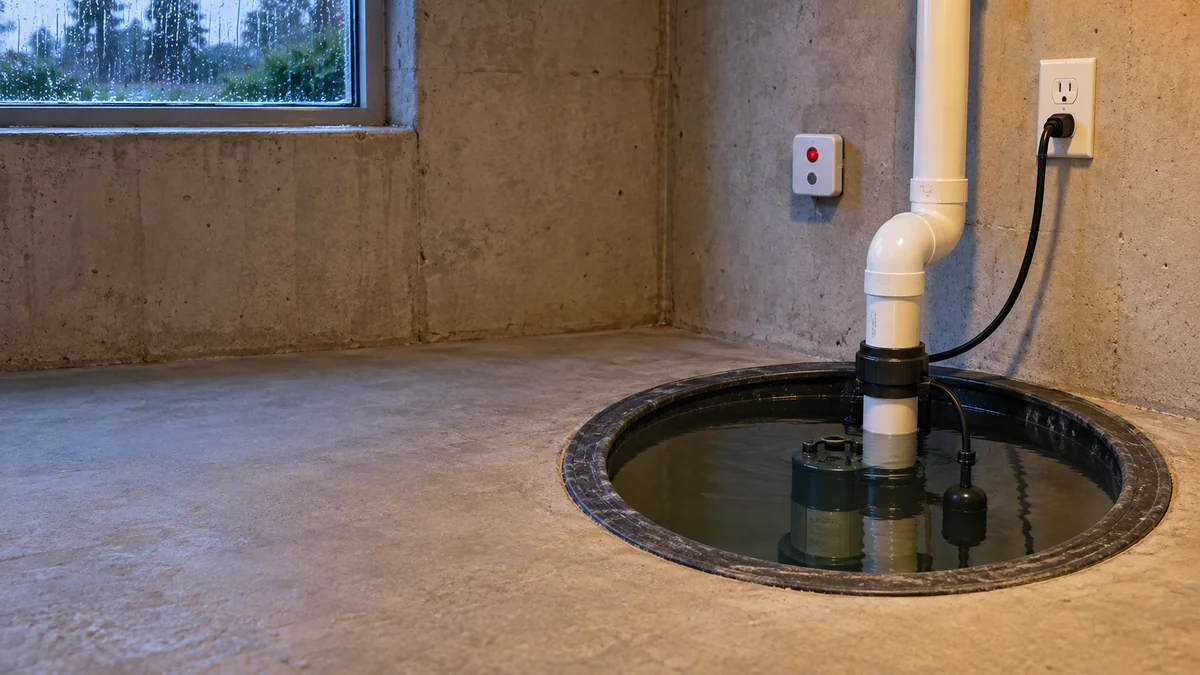
Sump pump not running during heavy rain? Let the rising water set the deadline for your first check.
Stay out if the floor, receptacle, plug, or panel is wet; move people and pets away and call emergency plumbing or water-removal help.
If every approach is dry, record how fast the water rises for 60 seconds before you touch any control, because a silent pump can restart without warning.
Use the home installation guide to record the model and the safe edge of the job. The smart-home troubleshooting map also separates power, control, and device failure.
Sump pump not running during heavy rain? Start with safety
Three failures can all look like a silent pump. The circuit can lose power, the float can fail to switch, or the motor can stop after a jam or thermal overload.
Heavy rain adds a fourth problem: water may enter faster than the installed system can manage.
Pentair’s troubleshooting guidance names the float switch as a common failure point, along with power, impeller, and motor faults. Those causes require different purchases.
Water changes the boundary of a normal inspection.
The Electrical Safety Foundation International says to avoid flooded areas until power has been confirmed off and to have water-exposed equipment inspected before reuse. A dry-looking pump cord does not make a wet floor safe.
Don’t step into water to reach the plug, outlet, breaker, float, or pump.
From a dry floor, listen without leaning over the pit. Silence with house power suggests a control or motor path; a dark house makes backup water control urgent.
A trapped float can leave a healthy motor silent. The switch needs open space around it, not merely more horsepower.
Run four checks only while the route stays dry
Stop these checks at water, damaged equipment, heat, or a burning smell. This is observation and model matching, not electrical repair.
-
Confirm the storm clock. Repeat a waterline photo after 60 seconds from the same dry position. Call before testing if water is near the rim.
-
Check the rest of the house. Look for normal lights. Don’t reset a wet GFCI, touch a wet panel, or assume one lamp proves the pump outlet is safe.
-
Watch the float without touching it. Check from dry ground for contact with the wall, pipe, cord, or debris. Never put a hand or metal tool into the pit.
-
Use the exact manual. A piggyback plug and an integrated switch have different tests. Follow the model’s instructions only while the plug area is completely dry.
Pentair allows a nonconductive handle for some floats and a switch bypass on certain piggyback-plug models. That is not permission to reach over energized water.
If the approved float test starts the pump, the switch or its clearance is the likely path.
If a model-approved test leaves the motor silent, unplug it from a dry location and stop. Thermal overload can reset as the motor cools, causing an unexpected restart.
If a breaker or GFCI trips again, leave it off and call an electrician. Repeated resetting can re-energize damaged equipment without removing the fault.
Never run a portable generator in a basement, garage, or near an opening.
Calculate the overflow clock before shopping
The useful number is time until overflow: visible freeboard divided by the rise in inches per minute.
Six free inches with a three-quarter-inch rise per minute leaves about eight minutes. Call now.
You can also estimate incoming flow from the basin diameter. A round 18-inch pit holds about 1.10 gallons per vertical inch, a 20-inch pit holds 1.36, and a 24-inch pit holds 1.96.
| Round pit diameter | Gallons per inch | If water rises 0.5 inch per minute |
|---|---|---|
| 18 inches | 1.10 gallons | About 0.55 gallons per minute |
| 20 inches | 1.36 gallons | About 0.68 gallons per minute |
| 24 inches | 1.96 gallons | About 0.98 gallons per minute |
Multiply gallons per inch by the observed inches per minute to estimate inflow. This geometry is an approximation for a straight-sided round basin, so use it to communicate urgency, not to certify pump sizing.
Don’t enter the room or lean over the pit to collect a better measurement.
Published flow changes with vertical lift and pipe resistance. Give the plumber the basin diameter, rise rate, lift, discharge size, check-valve location, and failed model.
The pump starts, but water still rises. The problem has changed.
That symptom belongs in the separate guide to a sump pump running but not pumping water. It can indicate a blocked discharge, check-valve problem, weak flow, or inflow beyond capacity rather than a no-start fault.
Buy protection for the failure you observed
A stuck external float does not automatically require a new pump. If the motor passes its approved test, compare a model-matched switch with replacement cost.
A silent motor that has dry, confirmed power but fails the manual’s test points toward pump service or replacement.
Match discharge diameter, switch clearance, basin size, vertical lift, and flow at that lift. A tethered float may bind where a vertical switch worked.
A whole-house outage needs independent backup power, not another plug-in primary pump. FEMA’s basement-flood guidance notes that primary pumps can stop when power fails or be overloaded by torrential rain and describes a battery backup as a safeguard.
Pair the backup with a battery-powered high-water alarm mounted above the primary switch level.
The alarm can’t remove water, but it can expose a silent failure early. Test it on schedule and keep its power independent from the primary pump.
A pump that runs without lowering the pit needs a system assessment. Ask about inflow, restrictions, lift, basin volume, exterior drainage, and the backup discharge route.
Don’t solve that result by buying the largest pump on the shelf.
From dry ground, record the waterline now and in 60 seconds. Divide free inches by rise per minute; under 15 minutes means call before diagnosing a sump pump not running during heavy rain.

Bolt & Bulb covers what goes wrong after the unboxing: devices that drop off Wi-Fi, dimmers that flicker with LED bulbs, locks that will not fit a rental door. The site draws on manufacturer documentation, platform support pages and release notes, and attributed owner reports in public forums.