A smart lock compatible with mortise lock hardware exists, but it must match the exact lock and door. If the maker cannot confirm your cylinder, case, backset, door thickness, handing, and lock function, do not buy it.
A standard US smart deadbolt is not a drop-in replacement for a mortise lock.
Start with the hardware, not the app.
This is a fit decision before it is a Wi-Fi, Matter, or HomeKit decision. The smart-home troubleshooting map can help after a supported lock is installed; it cannot make incompatible metalwork fit.
Smart lock compatible with mortise lock? Identify yours first
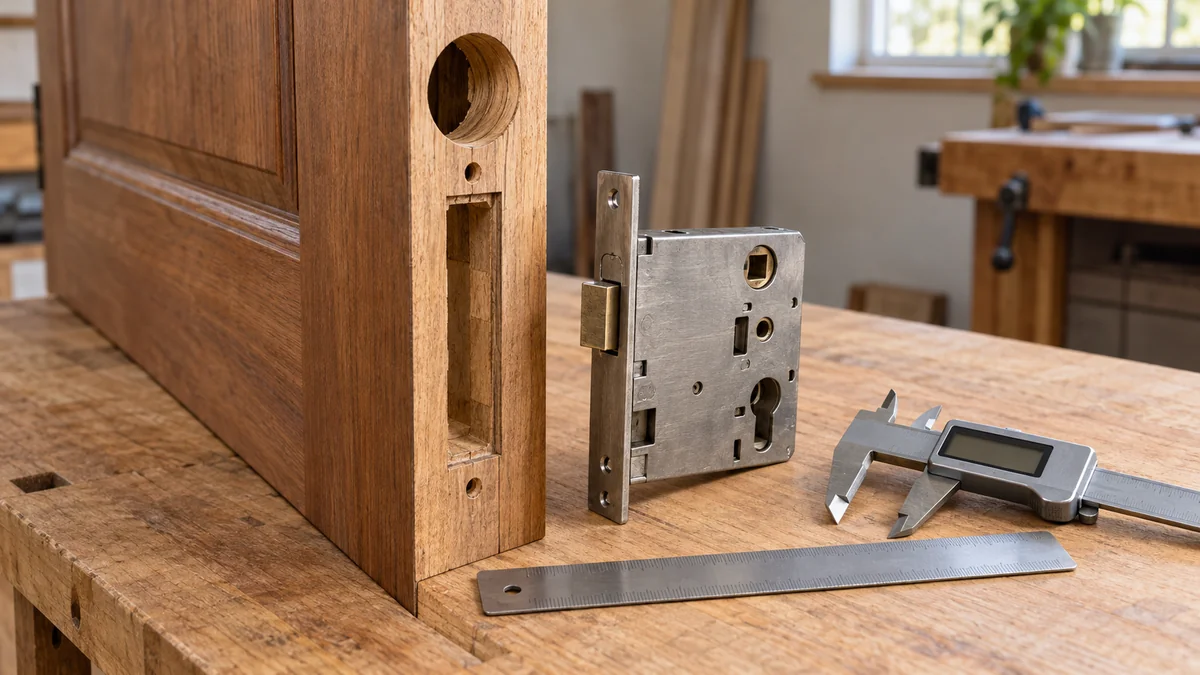
Open the door and look at its edge. A mortise lock usually has a long faceplate around the latch and deadbolt because a rectangular lock case sits in a pocket inside the door.
A tubular latch and a separate bored deadbolt use round holes instead.
Most US home retrofit locks are designed to turn the inside thumb turn of a single-cylinder deadbolt. They do not drive the parts inside a mortise case.
Do not rely on the listing word “mortise.” Region matters.
The official Aqara U200 manual, for example, supports European-standard mortise locks with specified Euro or Scandi cylinders.
Its US path is for single-cylinder deadbolts with 60 or 70 mm backsets. It does not promise support for US mortise cases.
Copy the manufacturer and model stamped on the door-edge faceplate. Photograph the outside cylinder, inside thumb turn, handle, full edge plate, hinges, strike, and any fire label without removing the lock case.
Those images answer more than a product-category filter.
Choose one of three purchase paths
- Retrofit the cylinder or inside turner. This keeps most existing hardware. It works only when the product officially supports the cylinder profile, the cylinder offers the required emergency function, the interior unit has clearance, and the lock can complete its normal throw without binding.
- Replace the full mortise set. The new case, trim, handle, cylinder, and strike are designed together. It is the cleaner route when an exact template matches, but it can expose old holes or require permanent door and frame work.
- Specify a commercial or access-control lock. This is the professional path for unusual US mortise functions, storefront hardware, common entrances, or doors that must retain a listing. It is not a consumer-lock experiment.
The first path is my recommendation for a renter. Use it only when the lock maker approves the current cylinder and the lease permits the interior device.
Otherwise, stop before purchase.
“There is no one-size-fits-all solution.” — a locksmith explaining mortise retrofits in r/Locksmith
A successful adaptation shown in a forum proves one lock function and one set of dimensions, not yours. Treat it as a lead to check, not proof that a product will fit.
A 60 mm backset still does not prove fit
Backset is the distance from the door edge to the operating center. It is only one line on the spec sheet.
A full fit check also needs the case size, faceplate, center-to-center spacing, and door thickness. Add the handing, trim clearance, cylinder, strike, and lock function.
| Fit-card line | What to record | Why it changes the answer |
|---|---|---|
| Identity | Maker, case model, and function code | Two cases that look alike can release the outside lever differently |
| Cylinder | Profile, cam or tailpiece, and emergency function | A retrofit motor must engage the correct part through its full travel |
| Case | Height, depth, width, backset, and faceplate | The pocket and door edge must accept the exact body |
| Centers | Lever, cylinder, and thumb-turn spacing | New trim must cover and operate the existing openings |
| Door | Thickness, material, handing, and interior clearance | Screws, shafts, handles, and battery body have fixed ranges |
| Constraints | Lease, common door, fire label, and required key access | A physically possible change may still be prohibited |
Published numbers show why every line matters. A Schlage L909x data sheet specifies a 113 × 154 × 25 mm case, 98 mm lever-to-cylinder spacing, and a 70 mm backset. Door-thickness options vary separately.
A residential Yale YMI70A specification lists a 60 mm backset and a 40–80 mm door-thickness range. Matching one shared number would not make those two systems interchangeable.
The numbers are a rejection tool. They are not permission to enlarge a mortise pocket until a different case fits.
Apartment and fire-door rules can end the search
A rental door may belong to the building even when the lock is inside your apartment.
Get written permission before you drill a hole or change the escutcheon, strike, or cylinder. You also need it for new hardware seen from the corridor.
Keep the landlord’s key and emergency-access requirement on the fit card. A motor that leaves a key inserted inside may block outside key operation unless the cylinder has the emergency function required by the retrofit maker.
A fire label changes the standard again.
Do not remove, drill, or mix components on a fire-rated door based on a marketplace listing or a successful home installation. Ask the building manager or a qualified locksmith to confirm that the complete door-and-hardware assembly keeps the required listing and egress operation.
Do the same for a shared entrance, storefront, panic hardware, electrified case, or multi-point lock. Consumer convenience is not enough evidence for those doors.
If your door turns out to use a separate bored deadbolt, read the four checks for keeping an existing deadbolt. If it needs new holes or trim, the home installation guide helps you separate door work from smart-home setup.
Reject any listing with one blank fit-card line
Send the completed card and photos to the manufacturer or locksmith and ask for approval of one exact model.
“Works with mortise locks” is not an answer. The reply should name the supported cylinder or case, size range, handing, function, and any required hub.
Stated plainly, prefer an officially supported cylinder retrofit when it preserves the door’s normal key and exit functions.
Choose a complete smart mortise set only with an exact template match and permission for the permanent work.
Avoid home-made tailpieces, drilled adapter plates, and a second deadbolt used to work around an unknown case. The first two can make the door unreliable. The third can create a new frame and permission problem.
A smart lock compatible with mortise lock hardware is decided by measurements, not by a brand search.
Photograph the faceplate now. Then fill every line before you search by brand.

Bolt & Bulb covers what goes wrong after the unboxing: devices that drop off Wi-Fi, dimmers that flicker with LED bulbs, locks that will not fit a rental door. The site draws on manufacturer documentation, platform support pages and release notes, and attributed owner reports in public forums.