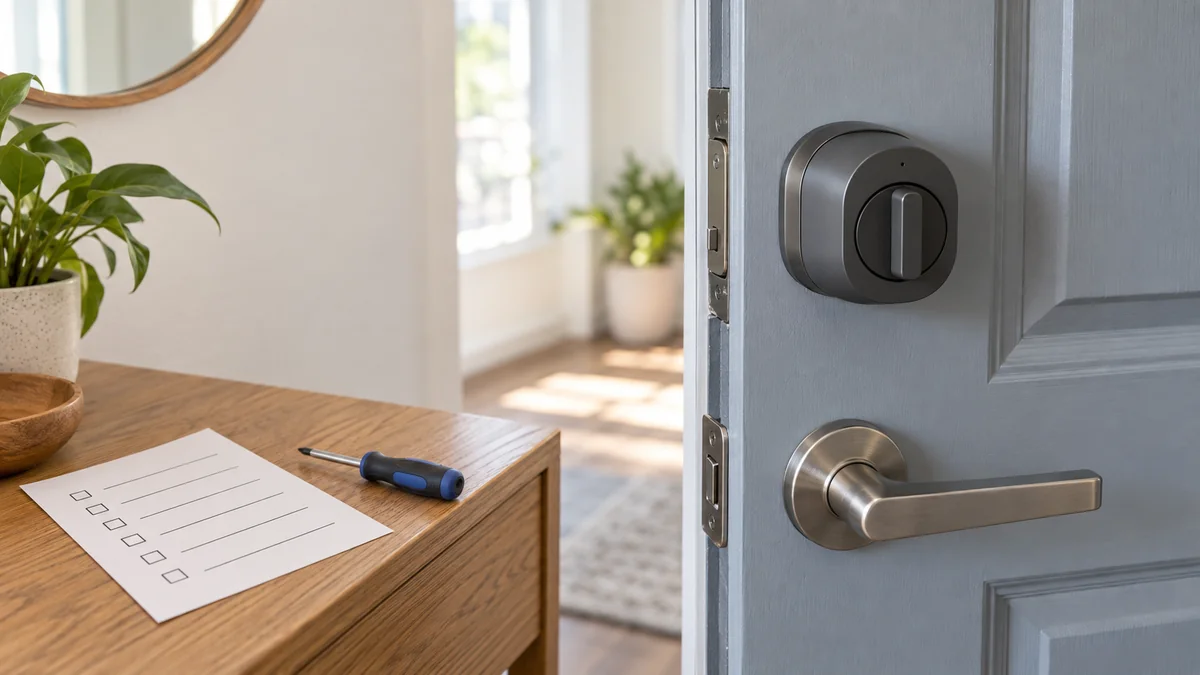
A smart lock without changing deadbolt hardware is possible when you have a compatible single-cylinder deadbolt and enough room on the inside of the door. The outside keyhole can stay, but “retrofit” doesn’t mean every product preserves the same parts.
Choose an inside-mounted model if you’re willing to remove only the interior thumb turn. Choose an in-door bolt model if you want to keep both visible sides but your door matches its stricter measurements.
Stop before buying if the lock is mortise, interconnected, rim-mounted, multipoint, or controlled by the building.
Smart lock without changing deadbolt starts with lock type
Look at what one turn of the inside hardware does. A common US single-cylinder deadbolt has a key cylinder outside, a thumb turn inside, and a separate latch or handle below it. That is the easiest starting point for a retrofit.
A long interior plate that joins the lever and deadbolt is an interconnected lock. A mortise lock has a larger case set into the door edge, while a multipoint lock moves hardware at several heights. These aren’t ordinary deadbolts wearing unusual trim.
Don’t use the diameter of the inside cover as your only clue.
One renter described being “not allowed to change the lock/deadbolt, but still in need of a smart lock” in a home-automation discussion. That wording captures two separate constraints: the landlord’s permission and the hardware’s fit. A removable device can satisfy one and still fail the other.
If the door is part of a building access system, has a master-keyed cylinder, or must release in one motion from inside, ask the property manager or a licensed locksmith to name the lock function. Don’t disable an exit feature to make a consumer motor fit.
Choose what you are willing to remove
There are two useful retrofit designs, and they preserve different parts.
An inside-mounted unit replaces the interior thumb-turn assembly while keeping the existing bolt, exterior cylinder, and key. August’s current retrofit guide says its locks attach on the inside and work with the existing deadbolt. Its compatibility note narrows that promise to single-cylinder deadbolts.
This is the practical default for a standard deadbolt when a larger motor housing can clear the lever, window trim, storm-door hardware, and door frame. You still need permission if the lease forbids removing interior lock parts, even when every original part can be reinstalled later.
An in-door unit takes a different route.
Level Bolt replaces the bolt and motor mechanism inside the door while reusing compatible exterior and interior housings. Level says you can keep the visible lock and key, but its verified deadbolt list matters more than the outside appearance. Some listed models need modifications, and many locks aren’t on the list.
| What you want to keep | Likely design | Reason to stop |
|---|---|---|
| Outside cylinder, existing key, and current bolt | Inside-mounted retrofit | Not a single-cylinder deadbolt or no room around the thumb turn |
| Both visible housings and the existing key | In-door retrofit bolt | Door measurements or deadbolt model don’t match the maker’s list |
| Every installed component | Clamp-over-thumb-turn design, if supported | Thumb-turn shape, torque, or adhesive surface isn’t approved |
| Interconnected or building-controlled function | Professional or building-approved solution | A consumer retrofit would remove an exit or access function |
The first row changes less inside the door. The second hides more of the technology. Neither choice is automatically more renter-friendly; the lease and the exact lock decide that.
Use four fit checks before checkout
- Name the lock. Confirm that the outside key operates a separate deadbolt with a thumb turn inside. If one lever retracts both latch and deadbolt, or the edge plate is unusually tall, stop using a standard-deadbolt checklist.
- Check inside clearance. Measure from the thumb-turn center to nearby trim, glass molding, the lever rose, and the frame. Compare those measurements with the installation drawing for the exact model, including any latches that swing outward during mounting.
- Check the door geometry. If you’re considering an in-door bolt, measure the bore hole, backset, door thickness, and bolt-hole depth. Level’s door requirements specify a 2 1/8-inch deadbolt bore, a 2 3/8- or 2 3/4-inch backset, and a 1 3/4-inch door for Level Bolt.
- Prove key and bolt operation. With the door open, turn the key and thumb turn through a full cycle. Repeat with the door closed. Any binding, need to push the door, or incomplete throw should be corrected before a motor is asked to overcome it.
Write the measurements beside the full product model, not the product family name. Accessories, generations, and regional versions can use different adapters or connectivity requirements.
Also separate fit from remote access. A lock may turn locally over Bluetooth yet need a bridge or compatible hub for control away from home. That doesn’t change whether it fits your deadbolt, but it changes the complete cost.
Get written confirmation, not a product photo
Buy only after the manufacturer confirms the exact lock type and measurements. A product page showing a round deadbolt isn’t confirmation for your tailpiece, interior plate, or strike alignment.
Fix door or strike binding before you fit a motor.
The smart-lock battery test explains why a motor fighting the frame can turn a correct purchase into short battery life.
If the retrofit requires drilling, moving a strike, or altering unfamiliar door material, use the home installation guide to identify the surface and the point where a locksmith or door professional should take over.
Your next move is simple: take the four photos, record lock type, inside clearance, bore, backset, and door thickness, then send that packet to the manufacturer before ordering. If one measurement or permission is missing, don’t guess. A smart lock without changing deadbolt hardware is only worth ordering after the fit is confirmed.

Bolt & Bulb covers what goes wrong after the unboxing: devices that drop off Wi-Fi, dimmers that flicker with LED bulbs, locks that will not fit a rental door. The site draws on manufacturer documentation, platform support pages and release notes, and attributed owner reports in public forums.