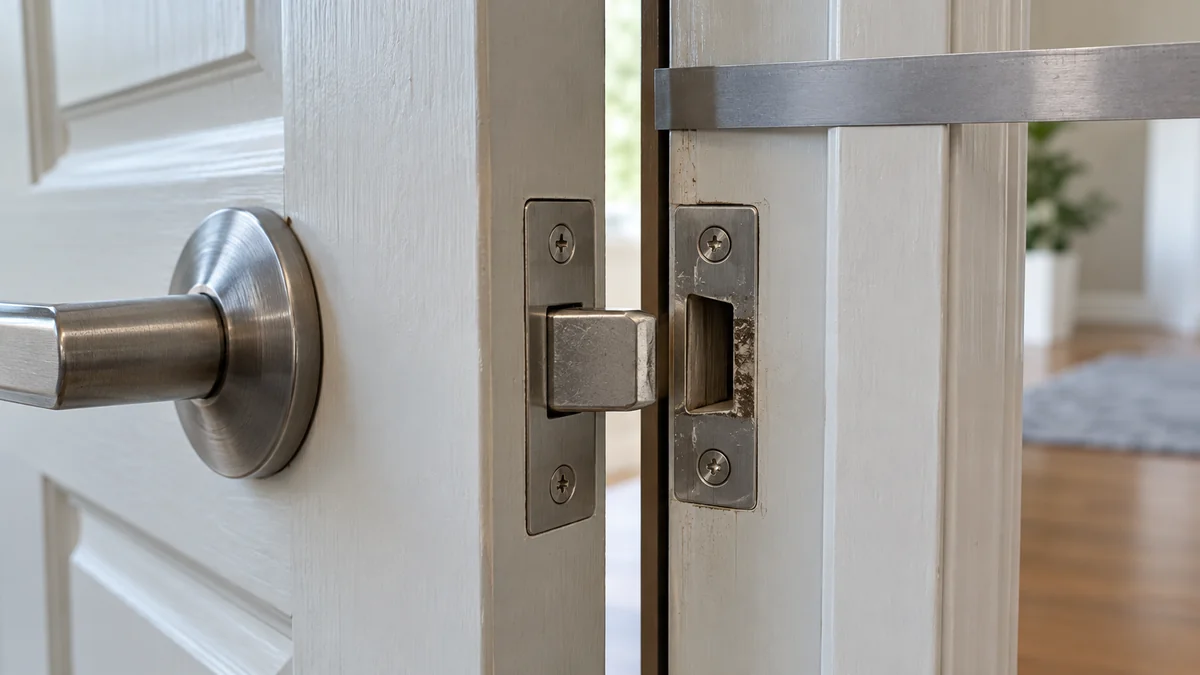
A door strike plate not lining up can begin at the hinges, frame, weatherstrip, latch, or bolt pocket rather than at the metal plate itself.
Operate the latch or deadbolt with the door open, then repeat without pushing, pulling, or lifting the closed door.
A change between those tests points to door fit before it points to failed lock hardware.
Leave the strike where it is until the door sits predictably and a contact mark shows the direction of the miss.
Door strike plate not lining up is a four-part diagnosis
The four parts are the moving latch or bolt, the door slab, the hinges and frame, and the strike with its pocket.
Changing the last part first can make the door latch today while leaving the cause untouched.
Start with the lock moving in free air.
Schlage’s official deadbolt test extends and retracts the bolt with the door open before repeating the test with it closed. The maker says a bolt that drags or hits the strike only when closed needs better strike or jamb alignment.
That sequence gives each result a job. Resistance with the door open keeps attention on the latch, bolt, mounting, or exact lock instructions; smooth movement while open but drag while closed shifts attention to door fit.
Keep a key or another documented entry method available before testing an exterior lock. Do not turn a diagnosis into a lockout.
Read the frame gap before the shiny rub mark
Stand on the closing side and look at the narrow gap around the door. Compare the top, hinge side, and latch side without assuming an old frame will be perfectly even.
A gap that widens toward one corner, a door edge that rubs, or a door that must be lifted to latch suggests that more than the strike position changed.
Schlage’s current door-alignment checklist separates seasonal fit, weatherstripping, the contact point, hinge sag, and bolt-pocket depth.
That matters because moving a plate cannot square a sagging door or remove pressure from thick weatherstripping.
Note whether the problem appears only in humid or cold weather.
A seasonal pattern is evidence to record, not permission to shave the door or enlarge the strike opening immediately.
If the frame gap stays consistent, the door closes without rubbing, and the hardware moves smoothly while open, a local strike or pocket mismatch becomes the stronger lead.
Take one straight-on photo of the whole closed door and one close photo of the strike area. The wide view keeps a local rub mark from hiding a larger change in the opening.
Make the latch show which direction it misses
Do not diagnose direction from memory.
Protect the jamb with removable paper or painter’s tape, rub chalk or lipstick onto the face of the latch or bolt, and let it touch the covered strike area once without forcing the door.
“I cannot figure out if the misalignment is horizontal or vertical,” one homeowner wrote in a Home Improvement Stack Exchange question.
The uncertainty is the useful part of that report. A clear high, low, inner-edge, or outer-edge mark turns “it does not line up” into a direction that can be compared with the frame gap.
Repeat the observation only if the first mark is unclear. Several different marks suggest the door is moving between closures, so filing one side of the opening is unlikely to be a complete answer.
A spring latch and a deadbolt can miss in different directions because they use separate pockets. Mark and test each one separately; a door that clicks shut can still leave the deadbolt dragging, while a smooth deadbolt does not prove the spring latch is aligned.
For a powered lock, compare manual movement rather than making the motor fight the strike repeatedly. Kwikset’s alignment check also compares manual operation with the door open and closed and tells users not to push or pull the closed door during the final test.
Match what you saw to the smallest sensible correction
Use all three observations together: free movement while open, the frame gap, and the contact mark. One observation alone cannot separate a misplaced strike edge from a door that has shifted.
| What you observe | What it points toward | Next decision |
|---|---|---|
| Latch or bolt binds with the door open | Lock hardware, mounting, or the latch mechanism | Check the exact model instructions or request lock service before changing the strike |
| Open movement is smooth, but the door must be lifted or pushed | Hinge, frame, weatherstrip, or door position | Correct the door fit or price a door repair before relocating hardware |
| Door sits square and one repeatable edge mark appears | Local strike position or pocket clearance | Use the lock maker’s listed strike option or have the existing strike adjusted |
| Gap changes by season or marks move between tests | Changing door or frame geometry | Record conditions and ask a carpenter or door professional to find the movement |
An adjustable strike is not the automatic winner.
It still has to match the latch or deadbolt, sit securely in sound framing, and preserve the security parts specified for that opening.
The same open-versus-closed comparison helps when a smart lock drains batteries while fighting bolt drag. In that case, correcting the door fit can solve the mechanical load before another battery or lock is bought.
Put the evidence in the repair request
Stop before cutting or drilling when an exterior door no longer secures, the jamb is split or soft, screws spin without holding, the opening is fire-rated, or the lock uses unfamiliar multipoint hardware. A locksmith or door professional needs the whole opening rather than a close-up of the plate.
Do not discard a supplied strike or reinforcement plate because a larger generic opening looks easier. Schlage’s installation guide identifies the strike and optional reinforcement plate as parts of its deadbolt assembly, so the exact model instructions belong in the decision.
Send four pieces of evidence with a repair request: the lock model, open-door result, closed-door result, and photos of the full frame gap plus the contact mark. Ask for separate prices if the diagnosis could mean door alignment or a local strike correction.
For other model-first installation choices, use the home installation guide. Start this one now by running the open-door test and taking the frame photo before loosening or buying anything.

Bolt & Bulb covers what goes wrong after the unboxing: devices that drop off Wi-Fi, dimmers that flicker with LED bulbs, locks that will not fit a rental door. The site draws on manufacturer documentation, platform support pages and release notes, and attributed owner reports in public forums.