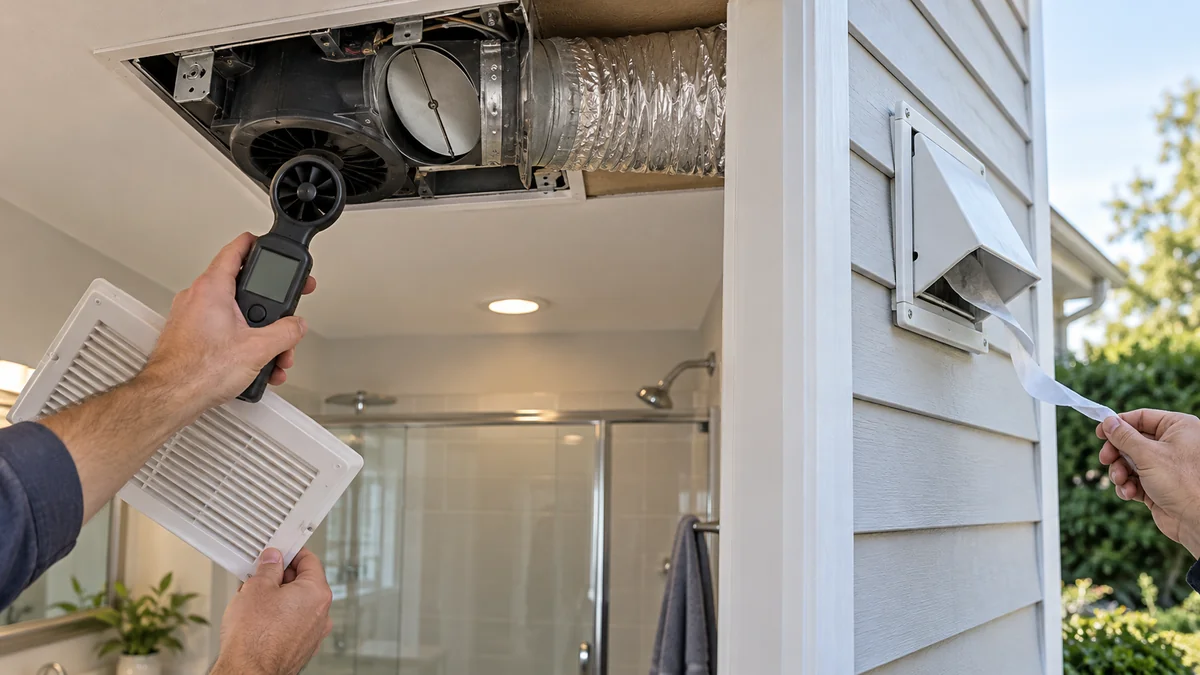
The fan runs, but the outside flap barely moves or stays shut.
A bathroom fan damper not opening does not prove that the damper is the failed part. The flap may be stuck, or the fan may not be delivering enough air through the duct to move it.
Do not buy a stronger fan yet.
Confirm where airflow stops, then match the repair to the exact fan, duct, and exterior termination.
Bathroom fan damper not opening can start anywhere in the path
A bathroom exhaust path has at least four working points: the room grille, the fan outlet, the duct, and the exterior cap or grille.
The visible exterior flap is only the last point. It cannot show whether air was lost earlier to dust at the grille, a restricted damper at the housing, a crushed flexible duct, an undersized connection, a sharp turn, or a disconnected run.
The Home Ventilating Institute maintenance guide says an accessible exterior termination damper should open while the fan runs and close while it is off. That makes flap movement a useful observation, not a complete diagnosis.
“I would have expected the flaps to open when the fan is on.” — DIY Stack Exchange homeowner
That homeowner first found a jammed flap, then later found that the installation lacked a proper duct through the wall. The report matters because it shows that a flap problem and an air-path problem can exist together.
Some designs also rest in different positions.
Broan-NuTone says its own dampers may remain slightly open when the fan is off, so do not judge an unfamiliar model by a generic photo. Use the exact fan and termination instructions to define normal movement.
Trace the air path in four safe observations
Keep this check on the room side and at safely visible exterior points. Do not climb onto a roof, reach into a running fan, open electrical connections, or remove fixed ductwork for diagnosis.
- Prove the motor is running. Listen for a steady operating sound and look for air draw at the room grille. If a HomeKit-controlled fan does not start at all, treat that as a control problem first; the HomeKit no-response guide keeps that branch separate from airflow.
- Compare airflow with the bathroom door open and nearly closed. A large change points to limited replacement air rather than a stuck exterior flap. Do not alter the door from this test alone; record the change for the installer.
- Observe the exterior termination from a safe position. Note whether the flap is closed, partly open, fluttering, or held open by wind. If it is on a roof or cannot be seen without a ladder, leave this observation to a qualified contractor.
- Check only accessible records and surfaces. Record the fan model, rated duct size, visible grille condition, duct type, approximate route, and cap model if known. Turn power off at the breaker before removing a washable room grille, then verify the wall switch cannot start the fan.
Do not push a high exterior flap with a pole or hold it open as a test.
If the flap binds where it can be reached safely from the ground, compare its movement and replacement part number with the termination maker’s instructions. A broken hinge, paint, sealant, debris, or wrong replacement cap calls for a model-matched cap or damper, not more fan power.
A stronger fan can still lose to a narrow duct
The fan’s advertised airflow is not the same as the airflow delivered at the outside wall.
Broan-NuTone defines static pressure as airflow resistance in the ductwork and says that resistance reduces fan effectiveness. Its guidance also says a smaller duct than the fan was designed for is not recommended, while rigid duct generally offers less airflow resistance than flexible duct.
This is why a running motor and a closed flap can point upstream.
The U.S. Department of Energy’s bath-fan duct job aid calls for ducting at least as large as the connection, a short route, supported duct without compression, and flexible duct pulled tight without kinks or U-turns. It also requires the fan to terminate outdoors.
Those details change the purchase.
A freely moving flap plus weak grille draw does not justify buying a new cap first. The better next step is a duct inspection for disconnection, crushing, blockage, poor support, or a route that does not match the fan instructions.
A clean air path plus a fan that cannot create useful draw may justify a model-sized replacement fan.
Do not choose that replacement by CFM alone. Match its outlet diameter, allowed duct length and fittings, room requirement, mounting space, electrical listing, and termination instructions; the site’s bathroom fan sizing guide explains why excess nameplate airflow can create a different problem.
The broader home installation guide uses the same rule: confirm the surfaces, dimensions, and published limits before buying hardware.
Turn four observations into one next move
Write down the result before contacting a seller or contractor.
- The fan starts normally or does not start.
- Room-side draw feels present, weak, or absent.
- The visible exterior flap is stuck, partly moving, or freely moving.
- The exact model, duct size, route, and termination are known or unknown.
If the flap is physically stuck or damaged while the room-side draw is otherwise strong, price the exact damper or exterior cap named for that installation.
If the flap moves freely but barely opens and the room-side draw is weak, ask for the duct route and delivered airflow to be checked before replacing the fan. A ventilation contractor can measure airflow and inspect concealed restrictions without turning this into guesswork.
If the duct is short, correctly sized, connected, and clear but delivered airflow remains poor, compare a replacement fan against the current model’s installation requirements.
Stop the check if you find heat damage, a burning smell, water near electrical parts, loose wiring, a failing motor sound, an inaccessible roof termination, or a duct that disappears into a concealed space without a verified outdoor exit.
The first action is simple: record those four observations while the fan is operating normally, then turn it off.
Use that record to buy one matched part or request one measured inspection, rather than replacing the damper and fan together.

Bolt & Bulb covers what goes wrong after the unboxing: devices that drop off Wi-Fi, dimmers that flicker with LED bulbs, locks that will not fit a rental door. The site draws on manufacturer documentation, platform support pages and release notes, and attributed owner reports in public forums.