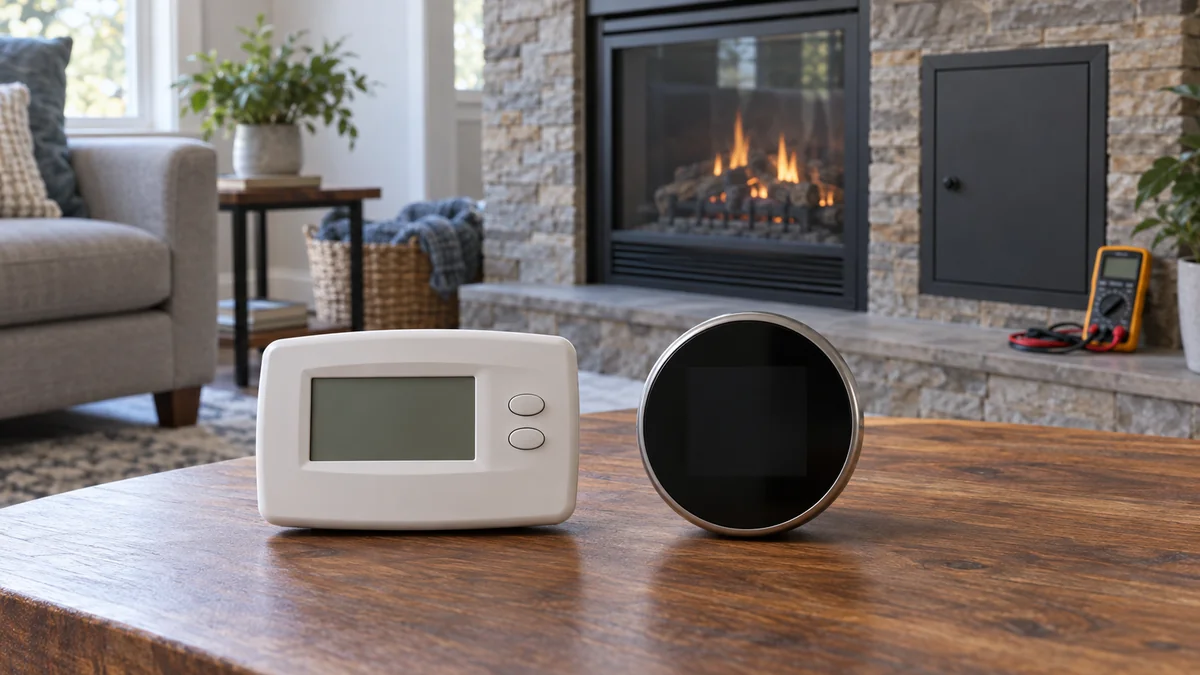
Smart thermostat compatible with millivolt system? Yes, but only a model whose manual explicitly lists millivolt switching.
Do not buy a Nest, Sensi, or ordinary Wi-Fi thermostat just because the old control has two wires.
First record the heater’s control rating, the exact thermostat model, and how that thermostat gets power. Those three lines separate a direct replacement from a professional relay-and-transformer job.
The buying rule: the manual must confirm the millivolt load and a usable power source separately. “Two-wire compatible,” “heat only,” and “works without a C wire” do not prove either point.
This is a compatibility decision, not a wiring project. If either rating is missing, keep the old thermostat in service and get the heater identified first.
For other connected-device purchases, the smart-home troubleshooting map uses the same model-first method.
If a new thermostat also needs a different wall position or larger backplate, plan that physical work with the home installation guide after compatibility is settled.
Smart thermostat compatible with millivolt system? Verify the rating
A millivolt heating circuit is not a small 24-volt HVAC circuit.
It is commonly found on gas fireplaces, wall furnaces, and floor furnaces where a thermopile produces the control power. Copeland says a millivolt system operates below one volt, while its Sensi thermostats are designed for 24-volt systems.
Google gives the same purchase boundary for Nest: its current compatibility page lists millivolt heaters as incompatible because they cannot supply the required thermostat power.
That does not mean every smart thermostat is excluded.
Honeywell Home’s support page says some of its thermostats work with 750 mV heating systems and notes that these models are typically battery powered. The exact package or literature still has to name millivolt compatibility.
One documented option is the Honeywell Home T6 Pro Z-Wave TH6320ZW2007. Its current professional installation guide says it can run on three AA batteries and works with millivolt systems.
The model suffix matters.
A T6 Pro Wi-Fi, T6 Pro Z-Wave, and another T6-family thermostat can have different power and load requirements. Match the full model number to the manual instead of buying by family name.
Two wires do not identify the control circuit
Two visible conductors can belong to millivolt heat, a 24-volt heat-only system, or a proprietary control. Wire count alone cannot tell you which one is on the wall.
Read the appliance rating plate and the existing thermostat literature before removing anything.
Look for a control specification such as 750 mV, millivolt, or powerpile. Also record the heater’s manufacturer and full model number, because its manual defines the permitted control rather than the thermostat’s wire colors.
If the label is hidden behind a sealed service area, stop there.
Do not open a gas appliance compartment, apply an external transformer, or test a live control circuit for this article’s checks. An HVAC technician should identify an unreadable rating and confirm any interface hardware.
“I’d rather not go down that route” was how one home-automation owner described adding an external supply and custom relay to a two-wire wall furnace.
That concern is practical, not cosmetic. A powered smart thermostat and an isolation relay create separate power, switching, enclosure, and failure questions that a direct-rated battery thermostat avoids.
It also explains why “no C wire required” is not enough.
A thermostat may steal power from a normal 24-volt circuit without a C wire yet still be unsuitable for millivolt switching. Another may run on batteries but have no millivolt load rating.
Choose direct support, a professional interface, or no purchase
Use the three-line card below before comparing apps, displays, or schedules.
| What the current manual says | Decision | What still needs checking |
|---|---|---|
| Exact thermostat model supports the heater’s millivolt rating and can run on batteries | Direct candidate | Heat-only setup, relay current limit, radio hub, and heater manufacturer approval |
| Thermostat requires 24 V but the heater is millivolt | Professional interface only | Approved transformer, isolated relay, enclosure, and failure behavior designed by an HVAC professional |
| Manual omits millivolt support or the heater rating is unknown | Do not buy yet | Written confirmation from both manufacturers or an on-site equipment check |
For a direct candidate, check the radio next.
The T6 Pro example uses Z-Wave, not Wi-Fi. Remote control therefore requires a compatible Z-Wave controller or gateway, and the thermostat’s current product documentation should be checked against that controller before purchase.
Avoid the tempting shortcut of buying a mainstream Wi-Fi model and adding parts afterward.
An isolation relay and separate transformer can be a valid engineered solution when the heater maker permits it. They are not universal adapters, and this is the point where a qualified HVAC professional should select, house, and test the components.
My recommendation is direct support first: choose a currently documented, battery-powered millivolt model that works with your existing smart-home controller. Reject any listing that says only “two wire,” “heat only,” or “C-wire optional.”
Questions to settle before you buy
Can a Nest thermostat work with a millivolt fireplace?
Not as a direct replacement. Google’s current Nest compatibility guidance lists millivolt heaters as incompatible.
A professional may be able to design a separate 24-volt interface for some appliances, but that is a system modification rather than Nest millivolt support.
Does a two-wire thermostat mean millivolt?
No. Two conductors describe the visible cable, not the control voltage or allowed switching load.
Use the heater rating plate and its manual, then confirm the exact thermostat model in current manufacturer literature.
Which smart feature should decide between compatible models?
Controller fit comes first.
A Z-Wave thermostat needs a compatible gateway, while a vendor-specific thermostat may require that company’s panel or service. Scheduling, remote access, and voice control matter only after the load rating and power source are proven.
Do this now: take one clear photo of the heater rating plate and one of the existing thermostat model label without disturbing appliance wiring. Compare those two records with the exact candidate manual before placing an order.

Bolt & Bulb covers what goes wrong after the unboxing: devices that drop off Wi-Fi, dimmers that flicker with LED bulbs, locks that will not fit a rental door. The site draws on manufacturer documentation, platform support pages and release notes, and attributed owner reports in public forums.