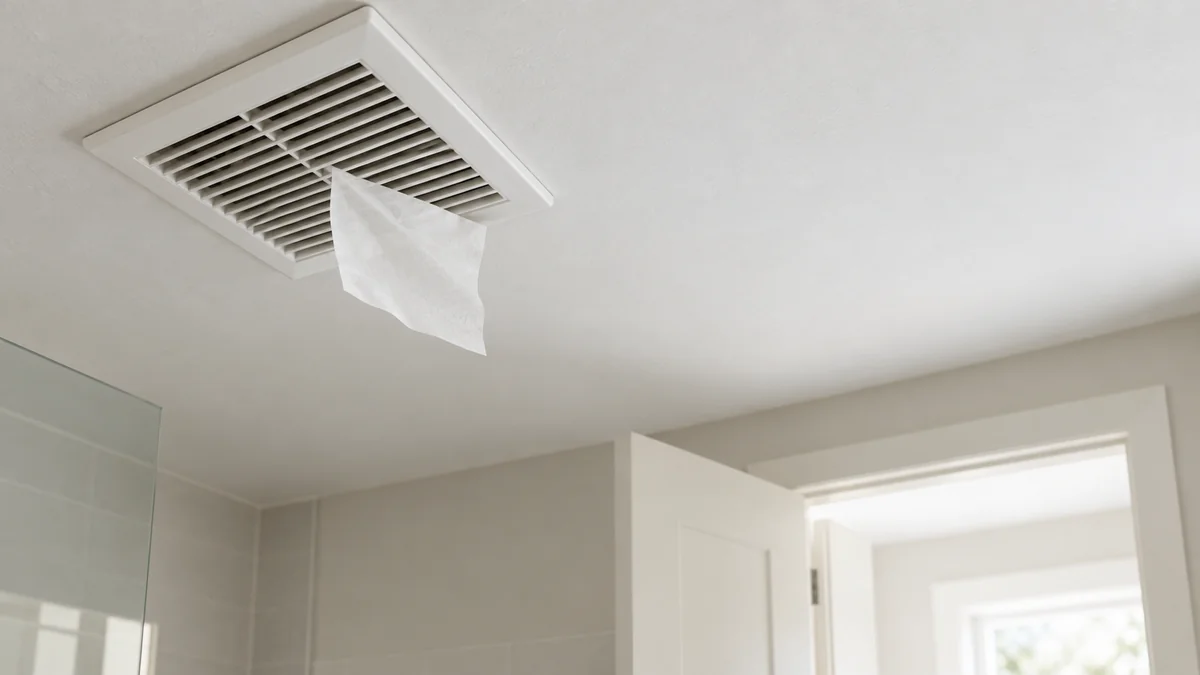
If your bathroom exhaust fan not pulling air problem comes with a normal motor sound, don’t buy a new fan yet. Test the grille, repeat the test with the bathroom door open, then watch the outdoor damper. Those three observations separate an intake blockage, a room starved for replacement air, and a hidden duct problem.
The motor’s sound only proves that something is turning. It doesn’t prove that moist air reaches outdoors.
Bathroom exhaust fan not pulling air three-location test
Start with a single square of light toilet tissue at the grille while the fan runs.
If it won’t stay up, airflow is weak. If it does stay, treat that as a screening result rather than a CFM measurement; the fan may still move too little air to clear shower moisture.
Next, close the bathroom door and note how firmly the tissue holds. Open the door two or three inches and repeat the same check without changing anything else. A clear improvement points toward restricted replacement air, not necessarily a bad fan.
Finally, look at the wall cap, roof cap, or soffit outlet from a safe ground-level position while someone switches the fan on. The exterior flap should open and air should leave the house. Don’t climb onto a wet roof or reach into a moving fan to finish this check.
If the outside termination isn’t visible from a safe place, stop there. An HVAC technician can measure airflow at the grille and inspect the full route.
These observations make a compact decision map:
| What changes | Most useful lead | Next move |
|---|---|---|
| Tissue improves after the grille is cleaned | Blocked intake or dirty blower | Maintain the exact model as its manual directs |
| Tissue improves only with the door open | Not enough replacement air | Have the door transfer path assessed |
| Weak at the grille and no flap movement outside | Damper or duct restriction | Inspect and measure the exhaust path |
| Good pull inside but steam still lingers | Run time sizing or duct delivery | Measure delivered airflow before replacing |
The closed door can make a healthy fan look weak
An exhaust fan can remove only as much air as the room can receive. Thick carpet, a new threshold, or a tightly fitted door can reduce that incoming path. The door-open comparison is useful because it changes one condition without opening the fan housing.
The Home Ventilating Institute’s bathroom guidance calls for a 3/4-inch clearance between the door and finished floor for makeup air. That number is a diagnostic clue, not an instruction to cut the door immediately. Flooring, fire separation, privacy, and local requirements can change the right repair.
If opening the door makes no visible difference, the bottleneck is probably elsewhere. Return the door to its usual position and follow the air path toward the fan and outdoors.
This one-variable method also appears in the smart home troubleshooting guide. The equipment is different, but the discipline is the same: change one input and record what actually moved.
A spinning motor is not delivered airflow
Dust on the grille and blower wheel is the accessible place to start. Switch the circuit off before removing a grille, confirm that the fan can’t start, and follow the cleaning instructions for your exact model.
Don’t spray cleaner or lubricant into the motor or wiring compartment.
After reassembly, run the three-location test again.
If suction stays weak, duct resistance moves up the list. A small duct, crushed flex section, sharp turn, sag, stuck damper, or blocked exterior cap can make a working motor deliver little air. The HVI maintenance guide specifically tells owners to inspect accessible duct connections and confirm that air exhausts outdoors.
The label CFM isn’t a promise for every installation. ENERGY STAR’s installed-performance rule requires certified bathroom fans to deliver at least 70% as much airflow at 0.25 inch water-gauge pressure as they deliver at 0.1. The practical meaning is simple: added resistance can reduce real airflow even when the fan itself is sound.
A disconnected duct can create the opposite trick. The grille may pull tissue well while moist air spills into an attic. The U.S. EPA’s bathroom guidance says adequate airflow must exhaust directly outdoors, not into an attic or another part of the house.
That is why the indoor tissue and outdoor damper belong in the same test.
Buy only after the failed section has a name
Cleaning wins when airflow returns after dust is removed. A door or transfer-air repair deserves attention when the fan improves only with the door open. Duct service is the better first quote when the outside flap stays shut or airflow disappears between the grille and termination.
Turn the circuit off and call an electrician if the fan hums without spinning, trips a breaker, smells burned, becomes unusually hot, or shows damaged wiring. Repeated resets aren’t diagnosis.
Water inside the fan housing is also a stop signal.
If replacement remains the answer, measure before choosing. HVI’s consumer guide uses at least 50 CFM for bathrooms up to 50 square feet and roughly 1 CFM per square foot above that baseline, but room size is only the starting point. The duct diameter, turns, length, and pressure performance decide what reaches the room.
Ask a contractor to put three items on the quote: measured airflow at the grille, the duct route and diameter, and the exterior termination condition. That turns “replace fan” into a repair you can compare across bids.
Persistent moisture can also come from the building surface rather than the fan. If the wet area is sealed inside insulated glass, use the window condensation location test.
For other mounting and upgrade boundaries, the home installation guide shows what to identify before opening a wall or ceiling.
Run the door-open comparison now, then watch the outdoor damper. Those two results will tell you whether your next step is cleaning, an airflow measurement, or a repair quote—not a blind fan purchase.

Bolt & Bulb covers what goes wrong after the unboxing: devices that drop off Wi-Fi, dimmers that flicker with LED bulbs, locks that will not fit a rental door. The site draws on manufacturer documentation, platform support pages and release notes, and attributed owner reports in public forums.