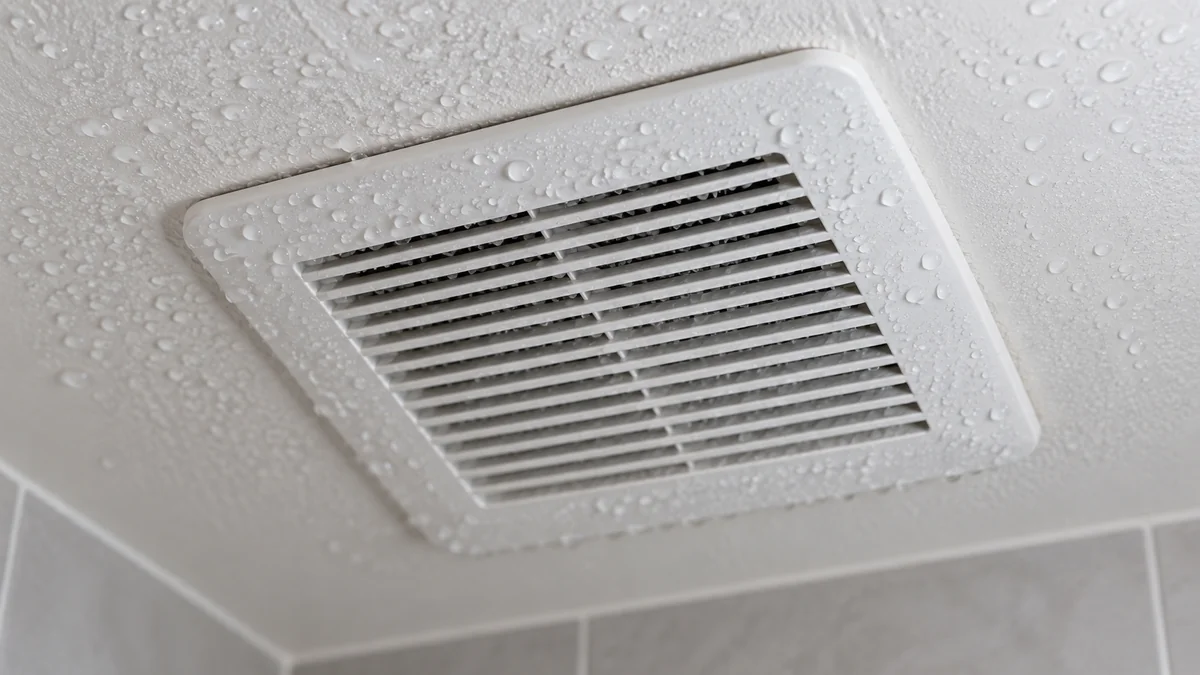
If your bathroom exhaust fan dripping water problem appears during or soon after a shower, suspect condensation inside a cold or poorly routed duct first.
If it appears only with rain, the roof cap, wall hood, flashing, or exterior seal needs inspection instead.
When water reaches the fan light, motor housing, switch, or wiring, don’t touch the wet unit; shut off its circuit only from a dry, safely accessible panel and have a qualified electrician assess it before reuse.
Bathroom exhaust fan dripping water needs a timing test
A fan grille is the exit point you can see, not necessarily the source. Warm shower air can cool inside a duct that crosses an unconditioned attic. Liquid then collects in a sag or runs along a route pitched back toward the fan.
Broan-NuTone’s official bath fan FAQ identifies two main branches: condensation from cold or improperly installed ductwork, and a failed seal at a wall or roof vent. The manufacturer recommends insulated ductwork and, for a wall termination, a downward slope that sends condensate outside.
That guidance changes the purchase decision. A louder or higher-capacity fan won’t repair a roof-cap seal, insulate an attic duct, or remove a low spot that holds water.
“It can be a 10 minute hot shower and the fan will be dripping.” — one homeowner’s report of a repeatable shower-linked drip
A repeatable link to shower use is useful evidence, although it doesn’t locate the cold section or prove the duct is installed correctly.
Make a simple two-event log. After the next shower, note the fan start time, shower end time, fan stop time, outdoor temperature, and first visible drop. During the next rain, check from the bathroom floor before the shower is used.
No ladder is needed.
Don’t use a dry ceiling stain as a substitute for timing; an old mark may remain long after the original water path changed.
The pattern matters more than the amount. Shower-linked water in cold weather favors duct condensation. Rain-linked water while the bathroom is unused favors an exterior opening. A drip with no shower or rain keeps plumbing and another roof leak in the case.
Four observations separate a wet duct from a roof leak
Start from the room and stay out of the fan housing. Take one photo of the grille and one of the ceiling around it. Brown rings spreading beyond the fan opening can show that water traveled through ceiling material, but color alone can’t tell you whether it came from rain, a pipe, rust, or dirty condensate.
- Match the event. Record shower, rain, snowmelt, or no obvious trigger.
- Watch the delay. A drip minutes after a shower supports condensation; water during rain with the fan idle supports exterior entry.
- Check room-side airflow. Without removing the grille, note whether steam clears and whether a tissue lightly held near the intake is drawn toward it.
- Look from safe ground level. If the wall termination is visible, note whether its damper opens while the fan runs. Don’t climb onto a roof.
Panasonic’s bathroom exhaust installation paper says smooth metal duct creates less resistance than flex duct, joints should be sealed, the duct should be insulated, and it should be slightly pitched so potential condensation drains outdoors. Those details explain why a running motor can coexist with water at the grille.
Airflow deserves a check because slow-moving humid air spends longer against a cold duct surface. A dusty grille may be cleaned according to the fan manual after power is safely disconnected, but weak draw can also come from a crushed flex run, excess bends, a stuck damper, or a blocked termination.
Don’t reach into the housing to prove which one.
Match the pattern to the right trade
Use the observations to choose the next move:
| Pattern | Likely inspection | Who to call |
|---|---|---|
| After showers, worse in cold weather | Duct insulation, pitch, sags, joints, and airflow | HVAC or ventilation contractor |
| Only during wind-driven rain | Roof cap, wall hood, flashing, and exterior seal | Roofer or exterior contractor |
| With no shower or rain | Plumbing and nearby roof paths above the fan | Plumber or leak investigator |
| Water inside the powered fan or light | Electrical damage before re-energizing | Qualified electrician |
The Electrical Safety Foundation International warns that re-energizing water-damaged electrical equipment without proper evaluation can cause shock, fire, or further damage. Dry-looking equipment isn’t automatically cleared for service. That is a clearance decision, not a drying-time estimate.
For a fan-light combination, visible water at the lens, motor housing, or internal opening is enough to stop room-side troubleshooting. Don’t switch a wet device on to “see if it still works.”
Build a contractor packet before anyone cuts the ceiling
A good service request is six lines long: fan brand and model, exterior vent location if known, shower timing, rain timing, whether the fan was running, and where the first drop appeared. Attach the two photos and the nearest outdoor temperature from your log.
This evidence narrows the first visit. An HVAC contractor can plan to inspect duct pitch, insulation, joints, resistance, and termination. A roofer can focus on the cap and flashing after a rain-linked event. An electrician can assess a wet fan assembly before anybody restores power.
The timing log makes that triage possible.
Ask the contractor to name the failed path before proposing a new fan. If the duct holds condensate, the quote should address its route, support, insulation, and outdoor termination. If rain enters at the cap, the quote should address the exterior defect rather than only replacing the ceiling unit.
The related bathroom exhaust airflow tests can help when the fan runs but steam stays in the room. Use the smart home troubleshooting guide only after the moisture and electrical safety issue is resolved; an app or humidity sensor isn’t the first problem here.
Start the timing log now.
Don’t replace the fan from the drip alone. Match the water to a shower and a rain event, photograph where it begins, and send that evidence to the contractor responsible for the failed path.

Bolt & Bulb covers what goes wrong after the unboxing: devices that drop off Wi-Fi, dimmers that flicker with LED bulbs, locks that will not fit a rental door. The site draws on manufacturer documentation, platform support pages and release notes, and attributed owner reports in public forums.