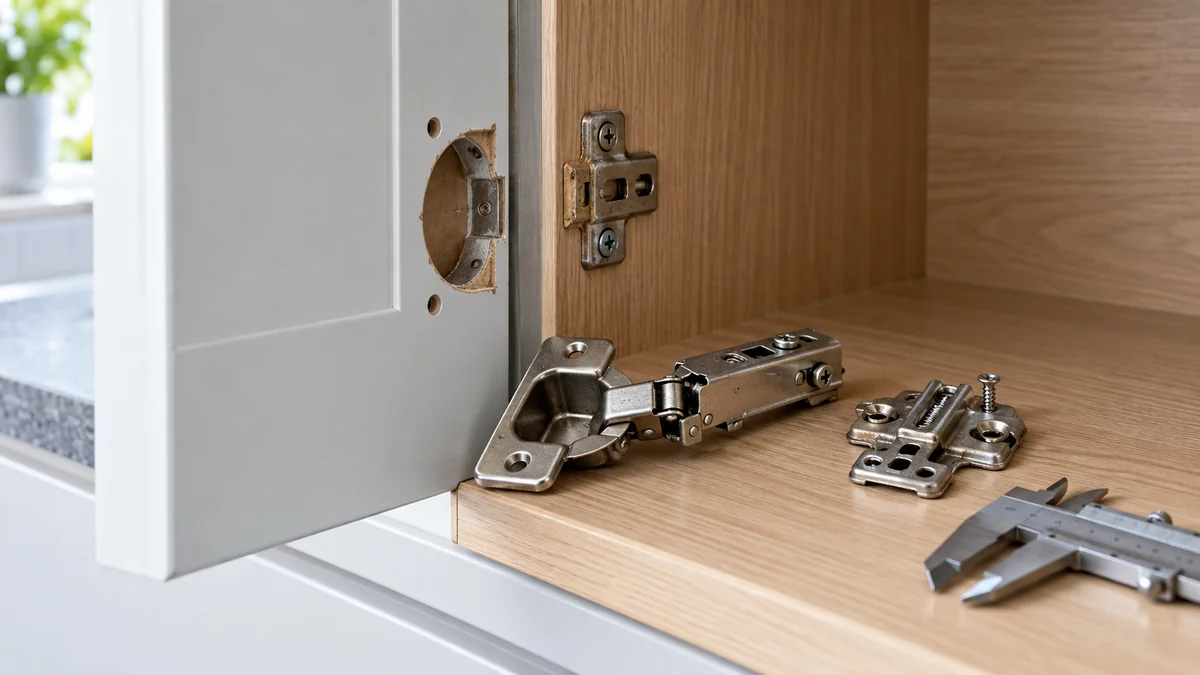
A cabinet hinge keeps coming loose because one of three connections is moving: the cup on the door, the hinge arm on its plate, or the plate on the cabinet.
Watch those connections while the door moves before tightening anything.
If a fixing screw spins without becoming firm, another turn is not a repair; the screw or the panel has lost its hold.
Buy a replacement only after you have the hinge maker, attachment type, plate height, door position, and hole pattern.
Stop turning screws until you know their jobs
A concealed hinge can put fastening, side adjustment, depth adjustment, and height adjustment within a few centimetres. Those controls are not interchangeable.
Blum’s CLIP mounting plate guide identifies a front screw for side adjustment, a rear screw or cam for depth, and separate plate designs for height adjustment. Its published adjustment ranges are only a few millimetres and differ from plate to plate.
That small range matters.
An adjustment screw near the end of its travel cannot compensate for a plate pulling out of the cabinet. Driving it harder may damage the hinge without restoring the fastener’s grip.
Use a hand screwdriver for the observation, not an impact driver. Support a large, mirrored, glass, or unusually heavy door before touching any attachment screw, and stop if the panel is cracked or the door could fall.
Cabinet hinge keeps coming loose? Isolate three joints
Open the door only far enough to see the hinge, then have another person move it slowly while you watch from the side. Keep fingers out of the folding hinge arm.
- Watch the cup against the door. A gap opening around the round cup or its fixing ears points to the door-side attachment, not the cabinet plate.
- Watch the arm against the mounting plate. If both bases stay still but the arm lifts, slides, or pops, check the exact clip or retaining method in the maker’s instructions.
- Watch the plate against the cabinet. A plate that rocks with its screws shows a fastener or panel problem. Door adjustment will not secure it.
Put a small piece of painter’s tape beside the suspected joint, never across a moving mechanism. Record a short video from the same angle so the stationary surface gives you a reference.
“The hinge plate in the vid looks loose … make sure mounting screws on the plate are tight.” — a reply to a cabinet owner whose hinge snapped during closing, r/cabinetry
The report is useful because it separates plate movement from the noise. It does not prove that every noisy hinge needs tighter screws.
Compare the bad hinge with another hinge on the same door. A missing clip, different screw head, bent arm, or plate that sits at a different angle is stronger evidence than the door’s sag alone.
A spinning fixing screw changes the repair
Mark the screw you believe fixes the hinge to the door or cabinet. Turn it gently by hand while watching the metal part and the panel.
A fixing screw that becomes firm while the plate stays flat may only have been loose.
A screw that rotates without drawing the plate tight has lost engagement. Stop, because a longer or wider screw can break through a thin panel, split a narrow solid-wood edge, or miss the fastening system the hinge was designed to use.
Hettich’s hinge technical catalogue says the attachment method must suit the type and quality of the door material and be tested for a secure fit. It lists different fixing arrangements for chipboard, MDF, aluminium, HPL, and solid-surface material.
The practical decision is material first, repair second.
A clean loose hole in solid wood, a crumbly particleboard hole, a pulled-out plastic or expanding insert, and a cracked door around the cup are four different failures. A generic “cabinet screw” does not solve all four.
If the panel is swollen, delaminated, cracked between the cup bore and door edge, or already carries an enlarged repair, remove the door from use and take the whole assembly to a cabinet professional. The panel may be the replacement item.
Match the hinge and plate before ordering hardware
Do not shop from the phrase “European hinge” alone. Two concealed hinges can look alike and still differ in overlay, inset geometry, opening angle, cup fixing, plate height, and clip design.
Photograph the complete hinge, every stamp or code, the cup in the door, the mounting plate, and one working hinge from the same cabinet. Add the door thickness and whether the door sits over the cabinet side, partly over it, or inside the opening.
Then compare the exact manufacturer’s catalogue.
Blum’s concealed-hinge catalogue shows mounting plates fixed with wood screws, system screws, press-in dowels, or expanding dowels. Even within one brand, the plate and fastener are a system rather than a universal pair.
A repair plate can be reasonable when it is specified for the hinge pattern, leaves the cup and arm aligned, and has sound panel around every fixing point. It is a poor blind purchase when its thickness shifts the door or its holes land in damaged material.
The same hardware-first order answers whether a smart lock is compatible with a mortise lock.
In both cases, the visible product category is less useful than the exact geometry already in the door.
The exact part beats a universal fix
Replace the hinge when its arm is bent, its clip no longer latches on the correct plate, a pivot is visibly damaged, or an identical working hinge proves the problem follows the hinge. Replace or professionally repair the panel when sound hardware cannot hold in the existing material.
Ask a cabinet shop to identify the part when no code is readable, the door uses a corner or bifold mechanism, multiple hinges have different plates, or previous repairs changed the holes. Bring the hinge, plate, photos, and measurements together.
For more decisions that begin with existing hardware rather than a shopping list, use the home installation guide.
Your next move is narrow: watch all three joints, mark the one that moves, and photograph the exact hardware before removing anything. That evidence turns “cabinet hinge keeps coming loose” into one part, one panel repair, or one clear request for a cabinet professional.

Bolt & Bulb covers what goes wrong after the unboxing: devices that drop off Wi-Fi, dimmers that flicker with LED bulbs, locks that will not fit a rental door. The site draws on manufacturer documentation, platform support pages and release notes, and attributed owner reports in public forums.