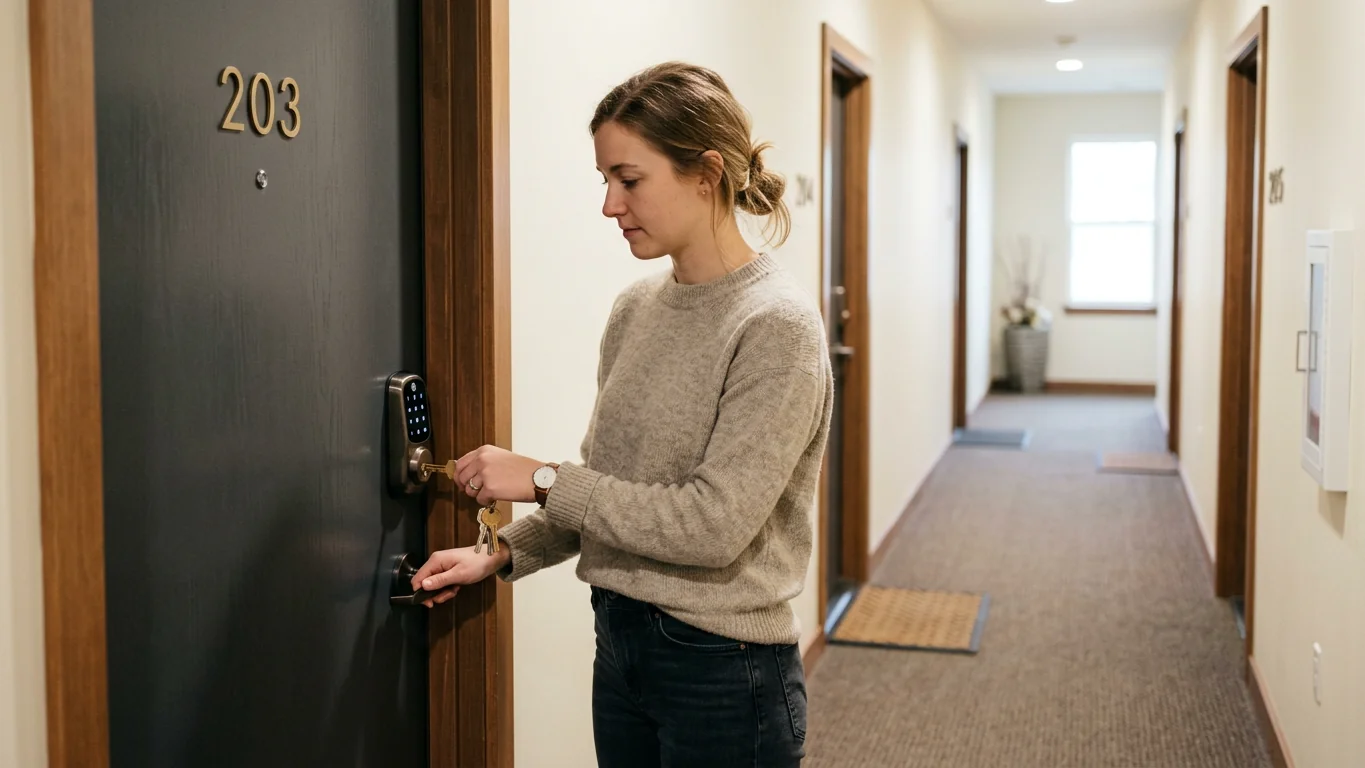
Yes, you can often add a smart lock to an apartment. Don’t buy one until you check the lease, lock shape, and fire-door status. The search query “can i install a smart lock in my apartment” still needs a conditional answer. The building may control the entrance hardware. An interior retrofit that keeps the outside key cylinder is usually the least disruptive choice. Written permission still comes first.
Take two photos before you shop. Shoot the lock straight-on from inside, then take one outside. Those photos will answer more than a product name will.
Why permission comes before the screwdriver
A renter and a homeowner can own the same deadbolt but have different answers. The issue isn’t the app. It’s who controls the entrance door, who needs emergency access, and who has to restore the hardware when the tenancy ends.
Read the sections of your lease labelled locks, alterations, security, access, and keys. Look for rules about written consent, duplicate keys, master-key systems, or changes to the unit entrance. Don’t assume that “no drilling” means “no permission.” A retrofit may still require the inside thumbturn to be removed.
That distinction shows up in what renters actually ask for: automatic locking inside, with the ordinary key still working on the outside. Treat that as a requirement, not a preference. Keeping the exterior cylinder preserves the manager’s existing key and doesn’t advertise a different lock in the hallway.
It doesn’t settle the lease by itself. Ask.
Can I install a smart lock in my apartment? Run 3 checks
- Get a written answer. Send the manager the exact model or type, say whether the exterior cylinder stays, and explain how you will restore the original hardware. A verbal yes from a leasing-desk employee is hard to prove at move-out.
- Name the lock you already have. A typical US single-cylinder deadbolt has a keyhole outside and a thumbturn inside. Mortise locks, interconnected handle-and-deadbolt sets, rim locks, multipoint doors, and apartment-wide electronic systems need different hardware. “Fits most doors” isn’t a compatibility result.
- Check the door’s building role. If the door self-closes, has smoke seals, carries a fire label, or belongs to a master-key or access-control system, stop before removing anything. Send the photos to the manager. The door may be part of the building’s fire and emergency-access plan.
Use the result, not the marketing, to choose:
| What you find | Decision before buying |
|---|---|
| Written approval plus a compatible single-cylinder deadbolt | Compare interior retrofit models that retain the exterior keyway. |
| Full-replacement lock or new exterior keypad required | Ask for model-specific approval and a key or access plan. |
| Mortise, interconnected, multipoint, or existing electronic lock | Do not guess from a compatibility list. Ask the manufacturer or a locksmith using photos and measurements. |
| Fire door, master-key system, or lease restriction | Do not modify it unless the responsible building contact approves the exact work. |
The table deliberately puts a fire door in a different row from an ordinary deadbolt. England’s flat entrance fire-door guidance (last updated 8 August 2025) covers changes residents make to their own front door, and it expects the responsible person to know about and agree to them. The routine door check it describes covers the door leaf and frame, the seals, and whether the door still closes fully onto the latch by itself.
That guidance doesn’t decide every lease. It explains the manager’s concern: the lock belongs to a tested door assembly, even when the new device looks removable.
Choose retrofit, not full replacement
For a renter with approval and a common deadbolt, an interior retrofit is the sensible default. It usually replaces or turns only the inside thumbturn. The keyed face on the corridor side remains in place, so the existing physical key can still operate the same cylinder.
“Retrofit” doesn’t always mean adhesive, tool-free, or universal. Read the installation manual before the product page.
August’s official Wi-Fi Smart Lock installation guide is specific. The keyed side stays in place while the interior thumb-latch comes off. A mounting plate goes on with a Phillips screwdriver, and an adapter sits over the tailpiece before the lock body attaches. That is reversible hardware work, but it’s still hardware work.
The practical meaning is simple. You need an intact original thumbturn, screws, and adapter at move-out. Put every removed part in a labelled bag on the day of installation. If you can’t restore the old lock without hunting for a missing screw, the installation wasn’t truly reversible.
Check four measurements or features against the exact model’s compatibility page:
- lock type and manufacturer, if marked;
- door thickness;
- backset, measured from the door edge to the centre of the lock;
- clearance around the interior thumbturn, trim, handle, and door frame.
Do the key test too. With the door open, turn the existing key and thumbturn several times. The bolt should travel freely without needing the door pulled or lifted. A motor won’t cure a bolt that already binds against the strike plate; it will only spend more battery trying.
When the honest answer is no
Stop if the manager says no, the lease requires the building’s cylinder, or maintenance cannot enter with its normal key. Don’t hide a replacement behind a promise to swap it back later. A security deposit dispute is a poor trade for auto-unlock.
Also stop when the apartment entrance is a fire door and the responsible person hasn’t approved the exact change. Don’t drill for a sensor, disturb smoke seals, remove a closer, or enlarge the lock opening. If the building approves a model but requires a locksmith or fire-door contractor, that condition belongs in the real cost.
A nonstandard lock is another clean stopping point. A mortise case is built into a pocket in the door edge. An interconnected set links the inside lever and deadbolt. A multipoint lock moves bolts at several positions. None should be forced into a single-cylinder-deadbolt checklist because a product photo looks close.
There is still a useful fallback. Ask whether the building can add you as a user to its existing electronic lock, issue another credential, or enable a temporary code. That can solve guest or cleaner access without touching the door.
Send this four-line request before you buy
Managers answer faster when the request already covers their objections. Keep it specific:
I’d like written permission to install an interior retrofit smart lock on my apartment door. The exterior cylinder and current key will remain unchanged, and building access will continue to work. I will keep the original interior hardware and restore it at move-out. Please confirm whether the door is fire-rated or part of a master-key system, and whether you require an approved installer or model.
Attach the two photos and the manufacturer’s compatibility page. If the manager approves only a particular model, keep that reply with the lease. If they ask for a duplicate key, confirm whether the exterior cylinder actually stays unchanged rather than cutting an unnecessary new key.
Once permission arrives, plan a reversible job with the home installation guide. Need app control? The Home Assistant smart-lock compatibility guide separates local control from cloud-only claims.
Do this now: photograph both sides and the edge of your open door. Send the four-line request before putting a lock in your cart. That one email answers “can i install a smart lock in my apartment” more reliably than any universal product list.

Bolt & Bulb covers what goes wrong after the unboxing: devices that drop off Wi-Fi, dimmers that flicker with LED bulbs, locks that will not fit a rental door. The site draws on manufacturer documentation, platform support pages and release notes, and attributed owner reports in public forums.