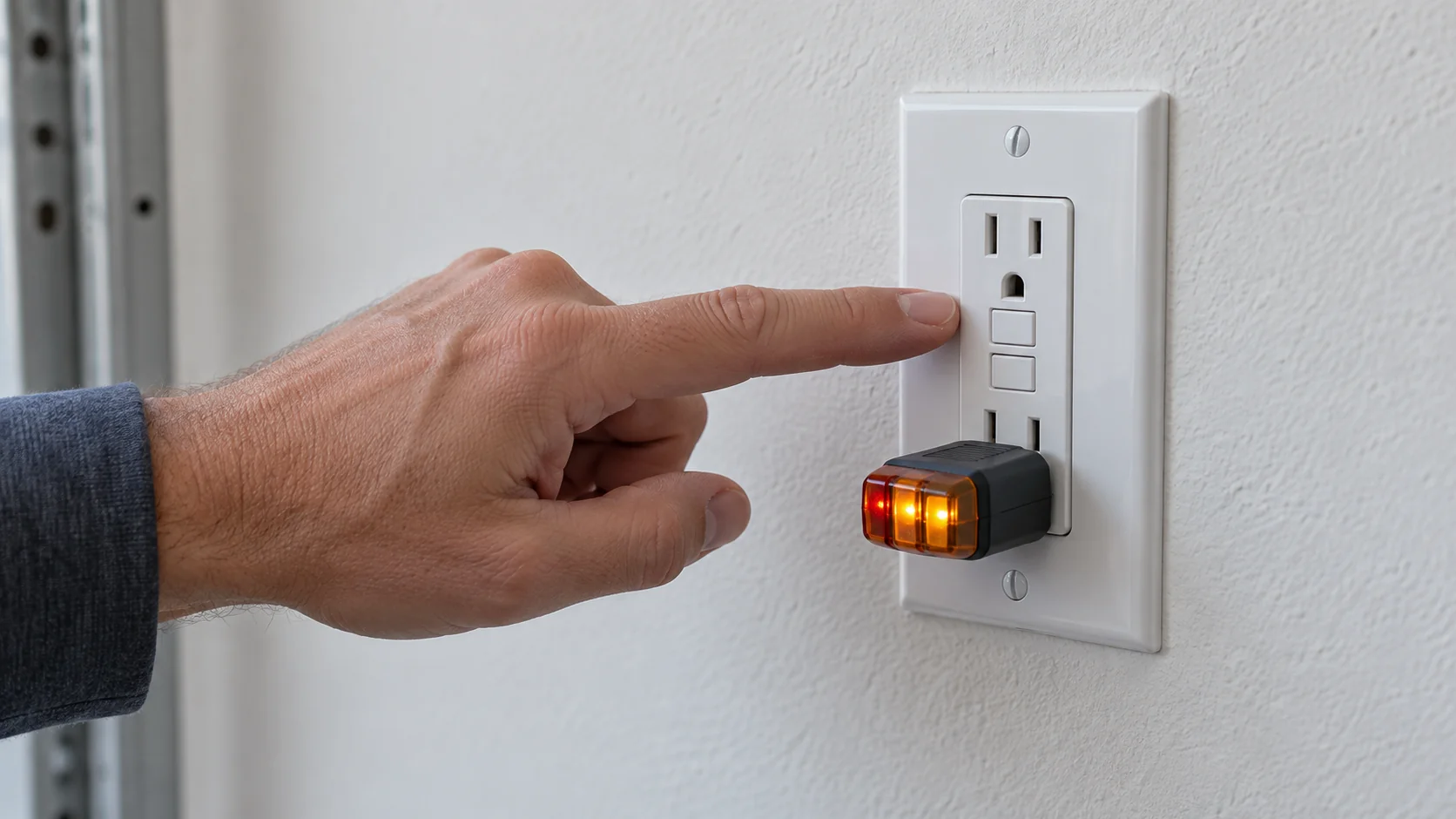
If a GFCI outlet won’t reset but has power, stop using it until it passes its own TEST button check. Power at the slots does not prove that the outlet can interrupt a ground fault. Keep the cover plate on, use a small lamp for one functional test, and switch the breaker off if TEST fails to cut power or RESET fails to restore it.
Don’t replace the receptacle just because an indicator glows. A powered face with failed protection, a healthy device that has not actually tripped, and a tester showing only line voltage can look almost identical. The lamp result and the movement of the two buttons tell you more.
Decision first: if TEST turns the lamp off and RESET turns it back on, the GFCI has passed this manual check. If the lamp stays on after TEST, the safety function is not confirmed; stop there, turn off the breaker, and have the device and its connections checked by a licensed electrician.
Why a live outlet can still fail its safety job
A GFCI compares the current leaving on one conductor with the current returning on the other. When some current takes an unintended path, the device should disconnect the load. That protection is a separate job from merely delivering electricity to a lamp, charger, or plug-in tester.
The U.S. Consumer Product Safety Commission GFCI fact sheet states that a GFCI receptacle can continue to provide power after it has stopped providing shock protection. That changes the decision. A glowing lamp is the starting condition for the test, not proof that the outlet is safe.
The wording people use can also hide three different observations. “Has power” may mean a real lamp runs from the receptacle, the GFCI’s own status light is on, or a non-contact voltage pen beeps near the face. Only the first shows that the slots are supplying a load, and none of the three confirms that the internal trip mechanism works.
Power somewhere on the circuit does not show what happens at the GFCI’s protected output. Use the front buttons and a known-working lamp to answer that question without removing the plate.
GFCI outlet won’t reset but has power 5-minute check
Use this sequence only at the finished face of the outlet. Don’t remove the cover, pull the receptacle forward, probe the box, or move conductors. If the outlet is wet, hot, discolored, cracked, buzzing, or giving off a burned-plastic smell, skip the test and switch its breaker off.
- Unplug every cord the GFCI may feed. Include nearby dead outlets in the same room or outdoor area. Leave hardwired equipment alone.
- Confirm the lamp elsewhere. Test a small lamp or night-light in another working outlet, then plug it into the GFCI.
- Press RESET firmly once. Never hold it in, tape it, or repeat the push to force the contacts closed.
- Press TEST once. The RESET button should move outward and the lamp should turn off. If it stays on, stop using the receptacle.
- Press RESET once more. The lamp should turn back on. If it does not, leave the outlet unused and check only the breaker or another accessible GFCI.
This follows the public test sequence from that CPSC fact sheet and the Electrical Safety Foundation International: a lamp starts on, TEST turns it off, and RESET restores it. Both sources direct users toward correction or replacement when the buttons fail to produce those results. The important part is the full sequence. Pressing RESET on an outlet that has not tripped proves very little.
If RESET holds with every cord removed, reconnect one at a time and stop using the item that trips it. If it trips unloaded, leave the cover on and call an electrician; the receptacle, moisture, downstream wiring, or hardwired equipment needs professional testing.
Read the result before buying a replacement
The table below is a decision map, not a wiring diagnosis. It tells you when an observation is enough to stop using the outlet and what information to give the electrician. It does not ask you to expose energized parts.
| What you observe | What the test establishes | Next action |
|---|---|---|
| Lamp stays on after you press TEST | Ground-fault protection did not pass the manual check | Turn the breaker off and have the GFCI and installation checked |
| TEST turns the lamp off; RESET turns it back on | The device passed this manual functional test | Restore only the loads that don’t cause another trip |
| TEST turns the lamp off; RESET will not restore power | The device is tripped but cannot return to service | Check the breaker and accessible upstream GFCIs; call if it still will not reset |
| RESET holds unloaded but trips with one appliance | That appliance or cord is associated with the fault | Stop using that item and have it inspected or replaced |
| RESET will not hold with every plug-in load removed | A simple plug-in load is not the cause | Leave the circuit off for an electrician to test |
A replacement GFCI may be the eventual repair, but buying one is not the first safe move. Modern devices can deliberately refuse to reset when they cannot provide protection, when no supply power reaches them, or when line and load were connected incorrectly during installation. Leviton calls this reset lockout. The refusal is a warning, not a button defect to defeat.
If the trouble started immediately after someone replaced the receptacle, tell the electrician that timing. If it began after rain, a leak, or a wet appliance was used, report that too. Those facts narrow the inspection faster than purchasing a second device and repeating an unverified installation.
A lit tester is not the same as a protected outlet
The photo at the top shows the trap: the tester glows, so the outlet looks alive. That only means its indicators found enough voltage and a recognizable wiring condition to illuminate. It does not override a failed TEST button, and a non-contact pen near the wall tells you even less about whether the GFCI will trip.
Read the indicator through the exact model manual
Don’t apply one brand’s red, green, or flashing-light chart to another brand. The indication can vary by product family and whether the button is set or tripped. Find the catalog number on the visible face or receipt, then use that model’s instructions.
A lighted receptacle tester is useful, but it isn’t a universal pass certificate. The Klein Tools RT250 instructions say the tester identifies common wiring conditions but does not show every defect or the quality of the ground. They direct users to an electrician if a GFCI test leaves the circuit energized. Read the lights as evidence for the next decision, not permission to keep using a failed outlet.
Never use either tool to decide that exposed wiring is safe to touch. Testing conductors inside the box requires the correct meter, a known-good verification routine, and the skill to identify line, load, neutral, and ground. That work sits beyond this covered-face check.
The same one-change-at-a-time rule appears in the smart home troubleshooting guide: hold the setup still and change one input. Here, that means removing plug-in loads before repeating TEST and RESET. It does not mean disconnecting wires to see what happens.
Switch the breaker off when the evidence stops
Turn the breaker off immediately for heat, scorch marks, smoke, buzzing, cracking, visible moisture, a shock or tingle, or a lamp that stays on after TEST. Keep people away from the outlet. If the affected circuit supplies a sump pump, medical equipment, freezer, or another critical load, arrange safe alternate power through a qualified professional rather than bypassing the GFCI.
Call an electrician when RESET will not hold with every cord removed, the breaker trips again, several outlets are dead, the device was recently installed, or you cannot identify what the GFCI controls. Never swap in a standard receptacle, wedge the button, or assume the breaker provides the same shock protection.
If the electrician confirms replacement is appropriate, ask for a listed self-test GFCI with the correct circuit rating and location rating. Let the electrician match the model to the circuit and verify every protected outlet afterward. The home installation guide uses the same boundary for other projects: identify the exact component and stop before the hidden connection becomes the job.
Run the lamp check now. If your GFCI outlet won’t reset but has power and TEST does not turn that lamp off, switch the breaker off and book a licensed electrician instead of pressing the buttons again.

Bolt & Bulb covers what goes wrong after the unboxing: devices that drop off Wi-Fi, dimmers that flicker with LED bulbs, locks that will not fit a rental door. The site draws on manufacturer documentation, platform support pages and release notes, and attributed owner reports in public forums.