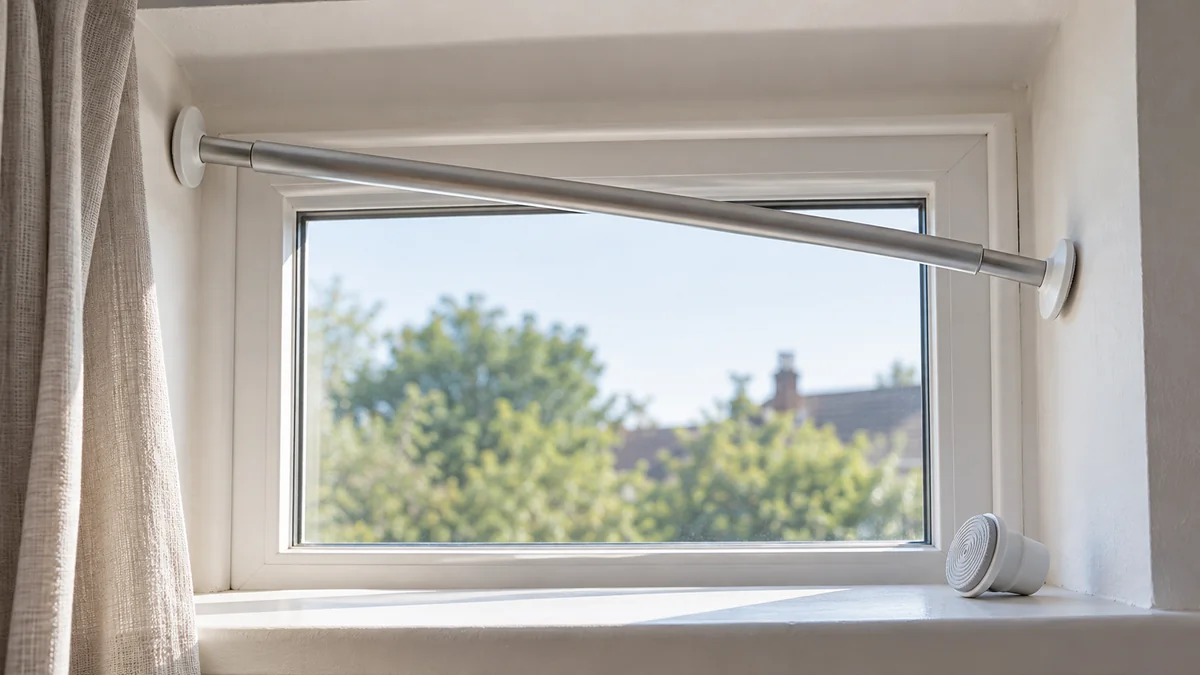
A tension curtain rod keeps falling when its end caps cannot create enough friction for the span and load.
Clean and dry both contact points, remove the curtain, and reinstall the bare rod once.
If it still slips with nothing hanging from it, stop tightening and replace the worn or mismatched rod, add holders approved for that surface, or switch to a fixed mount.
Tension curtain rod keeps falling at one of three interfaces
The failure can sit where the cap meets the wall, inside the rod’s locking or spring mechanism, or between the rod and the load.
Those faults look identical from the floor. The curtain drops, so the natural response is another hard twist, but extra compression can mark paint, crack brittle trim, or hide a mechanism that no longer holds its setting.
Start with the contact points.
Both end caps need broad contact with flat, dry surfaces. A cap resting partly on a grout line, rounded molding, loose paint, wallpaper seam, or dusty tile has less usable contact than its full diameter suggests.
Look at the caps under good light.
Glazing, hardened rubber, a missing pad, a bent tube, or a cap that no longer sits square is a product-condition problem. Cleaning cannot restore a torn cap or a lock that unwinds after installation.
The same order decides whether curtain rod anchors keep pulling out: identify what the hardware presses or pulls against before choosing the part.
Test the bare rod before blaming the curtain
Take down the curtain, rings, liner, lights, plants, and every other item on the rod.
Clean the end caps and contact areas with a method allowed for both materials, then let them dry fully. Soap film in a shower and furniture polish on trim can make a sound rod slide.
Measure the opening at the exact installation height.
Compare that number with the range printed for the exact model, not a similar listing. IKEA’s current BOTAREN tension rod, for example, is sold for a 47-to-79-inch span, while other rods use different ranges and mechanisms.
That range proves fit only for that model.
It does not supply a universal load rating, and it does not prove that every rod is equally stable at every point in its range. Use the maker’s instructions and stated load limit if one is published; do not borrow a number from another rod.
Install the bare rod level by following its own sequence. IKEA’s official BOTAREN assembly sheet shows the extension and spring-compression order for that product.
Do not hang from the rod or use your body weight as a test.
Give the center a small downward nudge while standing clear. Any visible slide, rotation, shortening, or cap movement means the bare installation has failed and should not be loaded.
Read one change at a time
Once the bare rod holds, add only the intended curtain and rings.
Watch what changes over the next opening and closing cycle. Pulling down on the fabric is different from sliding rings sideways, so open the curtain by moving the rings rather than tugging the hem.
| What happens | Most useful conclusion | Next decision |
|---|---|---|
| The bare rod slips immediately | Contact, span, setup, or mechanism has failed | Correct the surface and instructions once, then replace or change the mount |
| The bare rod holds but drops after the curtain returns | The installed load or downward pulling exceeds this setup | Reduce the load or choose hardware with a documented rating |
| One cap walks while the other stays | That contact point is uneven, contaminated, worn, or angled | Fix that interface rather than adding more force to both ends |
| The rod slowly shortens | The lock or adjustment mechanism is moving | Follow the model’s lock step or replace the rod |
A current retailer Q&A captures the frustrating version of this fault: “Mine keeps falling, any tricks to get it to stay?” The owner said the rod still fell every few days after following the installation video.
That reported failure is evidence that repeated setup can fail, not a specification for every rod. The practical lesson is to stop repeating an unchanged test.
Write down the opening width, rod model, stated range, curtain and liner combination, contact material, and which end moved.
That short record makes a replacement decision specific. It also gives a manufacturer or retailer enough detail to distinguish incorrect setup from a defective lock or worn cap.
Wall cups solve movement, not missing capacity
Small wall cups or rod holders can stop an end cap from walking down a surface.
They do not repair a rod that shortens, bends, or carries more than its documented load. They also move the weak point into adhesive, paint, tile finish, anchors, or screws.
Choose cups only when their maker names the wall material and rod diameter.
Adhesive holders need a clean compatible surface and enough cure time. Avoid treating them as permanent on loose paint, textured walls, damp grout, or wallpaper unless the product maker explicitly allows that surface.
Screw-mounted cups or brackets need a known support path.
A screw driven into an unknown hollow surface is not automatically safer than a tension rod. If the location needs anchors, first identify the wall material and use hardware documented for that material and the expected load.
The same fit discipline applies to connected hardware. A smart lock matched to a mortise lock also succeeds only when the exact mechanism and mounting surface are identified before purchase.
Use a fixed mount when another fall matters
A no-drill rod is a poor place to keep negotiating with gravity when it sits above a bathtub, child’s bed, pet area, glass object, stair landing, or busy doorway.
Remove a repeatedly falling rod from service until the fault is corrected. Do not prop it higher, wedge random objects behind the caps, or add fragile decorations that make the next fall heavier.
Keep the current rod only if the clean bare-rod test holds, the opening is inside the exact model’s range, the mechanism stays locked, and the intended load fits a published limit.
Buy a better-matched tension rod when the current span or mechanism is wrong but drilling is not acceptable. Choose model-matched holders when the rod is sound and the surface needs a positive stop.
Move to a fixed rod when the curtain is heavy, the opening is wide or uneven, people pull downward on it, or another fall could hurt someone or damage the surface.
One test comes first: remove the curtain and reinstall the bare rod on clean, dry contact points using the exact product instructions.
If the bare rod moves, do not load it again. Record the span and model, then choose hardware whose range, mounting method, and load are actually documented.

Bolt & Bulb covers what goes wrong after the unboxing: devices that drop off Wi-Fi, dimmers that flicker with LED bulbs, locks that will not fit a rental door. The site draws on manufacturer documentation, platform support pages and release notes, and attributed owner reports in public forums.