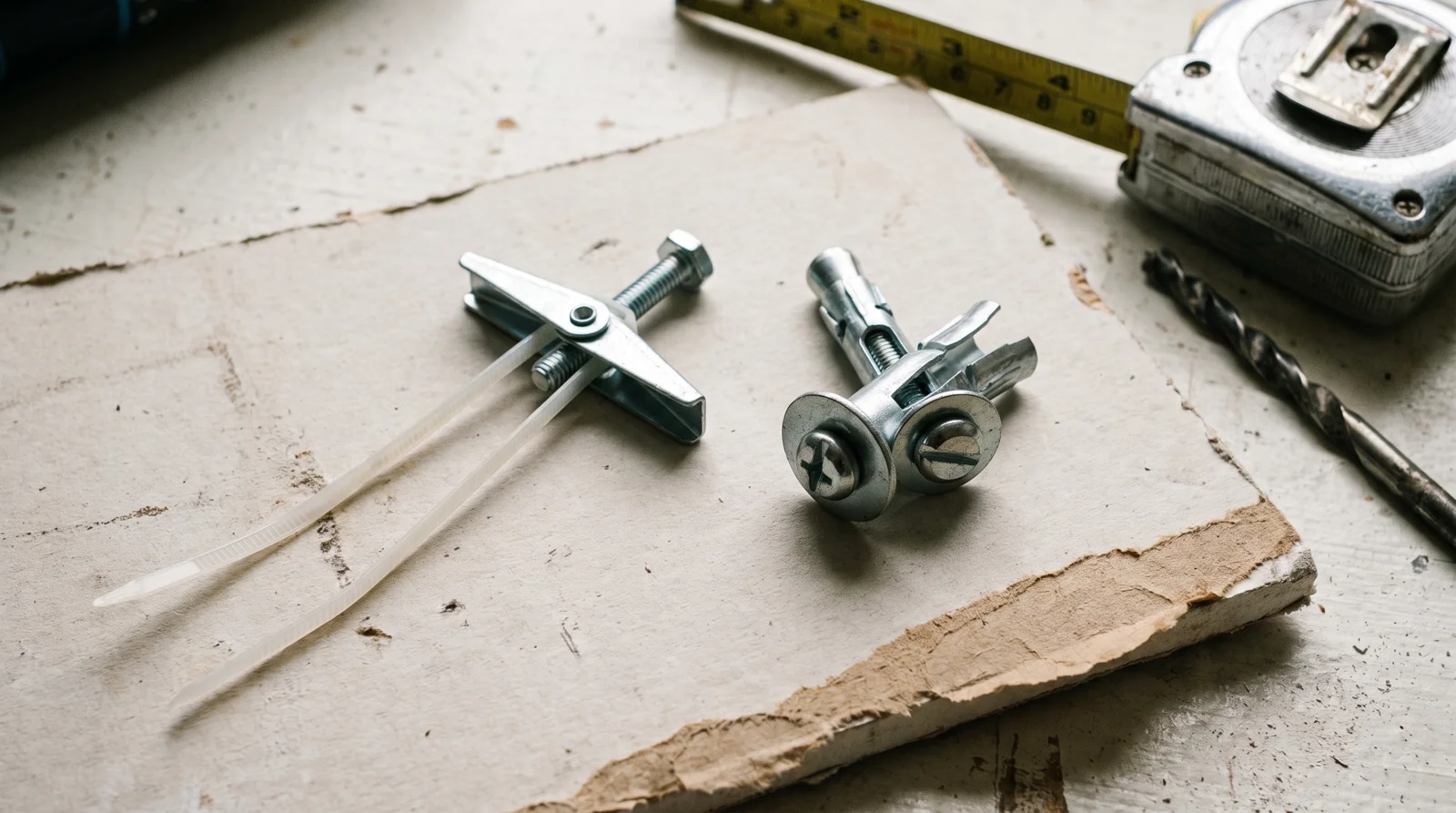
Toggle bolt vs molly bolt which is stronger? The toggle, and it isn’t close — as long as you mean a strap toggle. TOGGLER’s published lab data puts its 1/4-20 SNAPTOGGLE at 265 lb ultimate pull-out in half-inch drywall. A metal molly of roughly the same size gets quoted at about 50 lb.
The gap shrinks if you mean the old spring-wing toggle, the one with the folding butterfly on the end. That one lands nearer the molly than it does the strap toggle, which is why the advice you see repeated online is right for the wrong reason.
And all three of those numbers describe a sheet of drywall in a testing lab. Not your wall. Divide by four before you hang anything on them.
Toggle bolt vs molly bolt which is stronger, side by side
Three different fasteners get called a toggle or a molly at the hardware store, and they don’t behave alike.
| Anchor | Rated in 1/2″ drywall | What happens when you take it out |
|---|---|---|
| Strap toggle (SNAPTOGGLE 1/4-20) | 265 lb pull-out, 241 lb shear — maker’s lab figures | Metal channel stays put. Bolt comes out and goes back in. |
| Spring-wing toggle | TOGGLER claims a strap toggle carries “up to 2x the load of an old-fashioned wing toggle” | Wings drop into the cavity the second the bolt clears the back of the board. |
| Metal molly | About 50 lb, per fastener suppliers | Sleeve is splayed open for good. Only the screw comes out. |
All Points Fasteners puts the middle of that range plainly: “Typically, a metal hollow wall anchor can support up to about 50 lbs. in a 1/2-inch drywall.” Jerry Alonzy, the Natural Handyman, gives the wing toggle a safe load of 30 lb for a 1/8″ and “over 50 lbs” for a 3/8″.
Notice the hole sizes run the other way. A 1/4″ wing toggle needs a 3/4″ hole — TOGGLER points out that’s 50% wider than the 1/2″ hole its own 1/4″ anchor uses, and a molly’s hole is smaller still. The weakest anchor of the three asks you to cut the biggest wound in the wall.
The number on the box is where the wall broke
Read the fine print under TOGGLER’s load table. On the tests run with a steel stud behind the board, the footnote says failure was “measured as breakage of drywall portion.” The anchor didn’t give. The gypsum did.
Alonzy says the same thing with more exclamation marks: “the wallboard will fail before the toggle!!” InspectAPedia adds the part that actually ruins your afternoon — hanging a heavy load on a toggle in drywall “risks deforming or tearing the drywall such that the object might still fall.” The anchor holds. The wall sags around it, and down comes the shelf.
So use the manufacturer’s own math. TOGGLER’s note is one line: “Industry standards recommend 1/4 of ultimate test load.” That 265 lb becomes 66 lb of working load. The molly’s 50 lb becomes something in the low teens.
The same note buries a second warning worth more than the first. Holding strength varies “inversely with variations in hole diameter and the distance of the load from the wall.” A picture hanging flat against the plaster and a shelf sticking out ten inches are not the same load, even at the same weight. The shelf is a lever, and the anchor is the fulcrum.
Printed ratings overpromise in other aisles too — the wattage stamped on a dimmer has exactly this problem with LED bulbs.
Picking one in about a minute
Four checks, in this order. The first one decides most of it.
- Measure the wall. Drill your hole, push a bent paperclip through, hook it on the back and pull. Both anchors are sold by wall thickness, and a mismatch is silent — as one answer on a DIY Stack Exchange thread about towel bars puts it, “Too short and the wings wont open. To long and the wings will open but not pressing to the drywall from inside.”
- Reach behind the wall. A SNAPTOGGLE needs 1-7/8″ of clear cavity to swing into. Behind a door skin, a shallow soffit or a wall with a pipe run in it, you don’t have that, and the molly becomes the only candidate.
- Ask whether it ever comes off again. Strap toggles and mollies both survive removal. A wing toggle is a one-way trip — take the bolt out and the wings are gone.
- Multiply. Take the real weight, times four, and check that against the number on the packet. If the packet loses, you’re looking for a stud.
My flat recommendation for anything that matters: strap toggle, every time. It costs about a dollar more per anchor and it’s the only one of the three you can undo without patching.
Where the molly still wins
It sits flush. A molly’s flange finishes level with the wall, so a bracket sits tight against paint instead of rocking on a plastic collar, and the hole it leaves behind is a hole you can fill with a fingertip of compound.
That’s a real advantage in a cavity too thin for wings, and on lath and plaster, where a 3/4″ bit does more damage than the anchor is worth.
The molly’s failure mode is worth knowing before you’re standing there with a screwdriver. Alonzy’s description: “Turning the screw can cause the molly to spin, especially if the installation point has been repaired before OR if you are installing the molly on a hard surface such as on a hollow-core door.”
Once it spins, it never sets and it won’t back out. Set mollies with a molly setting tool that pulls the sleeve, not with the screw and a drill.
When neither one is the answer
The best-voted reply on that towel bar thread starts with two words: “None of them.” The reasoning is the sentence I keep coming back to — “People don’t start slipping and grab a picture or a mirror. But they do grab towel bars.”
Anything a person might catch themselves on belongs in wood. A grab bar isn’t even a judgment call: the ADA figure is a 250 lb force “at any point on the grab bar, fastener, mounting device, or supporting structure.” No hollow-wall anchor is in that conversation. Same for a TV mount, and for tall furniture you’re strapping to the wall so it can’t tip.
Shelves are the borderline case, and the honest test is what goes on them later. A floating shelf holding a mesh node off the floor — one of the fixes when a speaker keeps dropping off your wifi — will never see 20 lb. That shelf is fine on two strap toggles. The same shelf in a kitchen ends up holding cookbooks and a stand mixer within a year.
Do this first: before you buy anything, run a stud finder across the spot and check 8 inches either side. The strongest anchor in this article is still the second-best option on the wall.
More in this section: Home installation guide for anchors, dimmers and LED strips.

Bolt & Bulb covers what goes wrong after the unboxing: devices that drop off Wi-Fi, dimmers that flicker with LED bulbs, locks that will not fit a rental door. The site draws on manufacturer documentation, platform support pages and release notes, and attributed owner reports in public forums.